
Sunday, May 31, 2026
Home Blog Page 154

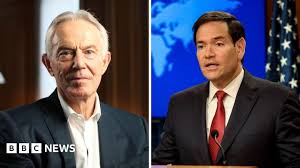
Blair and Rubio among names on Gaza ‘Board of Peace’

0

The Trump administration has named US Secretary of State Marco Rubio and former UK prime minister Sir Tony Blair as two of the founding members of its “Board of Peace” for Gaza.

Trump’s Middle East envoy Steve Witkoff and the president’s son-in-law Jared Kushner will also sit on the “founding executive board”, the White House said in a statement on Friday.

Trump will act as chairman of the board, which forms part of his 20-point plan to end the war between Israel and Hamas.

It is expected to temporarily oversee the running of Gaza and manage its reconstruction.

Also on the founding executive board are Marc Rowan, the head of a private equity firm, World Bank chief Ajay Banga and a US national security adviser, Robert Gabriel.

Each member would have a portfolio “critical to Gaza’s stabilisation and long-term success”, the White House statement said.

Trump had said on Thursday that the board had been formed, calling it the “Greatest and Most Prestigious Board ever assembled at any time, any place”.

Further members of the board would be named in the coming weeks, the White House said.

Canadian media, citing senior government officials, has reported that Canadian Prime Minister Mark Carney has been asked to join the board and intends to accept the invitation. The BBC has contacted Carney’s office for comment.

Sir Tony was UK prime minister from 1997 to 2007 and took the UK into the Iraq War in 2003. After leaving office, he served as Middle East envoy for the Quartet of international powers (the US, EU, Russia and the UN).

In this role, he focused on bringing economic development to Palestine and creating the conditions to move towards a two state-solution.

Sir Tony had already been a part of high-level talks about Gaza’s future with the US and other parties. In August, he joined a White House meeting with Trump to discuss plans for the territory, which Witkoff described as “very comprehensive”.

In a statement, the former prime minister said he was honoured to be appointed and it had been a “real privilege” to work with Witkoff and Kushner so far.

“I look forward to working with them and other colleagues in line with the president’s vision to promote peace and prosperity,” Sir Tony said.

He is the only founding member of the executive board who is not a US citizen.

In September, Health Secretary Wes Streeting told the BBC that involving Sir Tony in such talks, given his record on the Iraq War, would “raise some eyebrows”.

But Streeting also noted the former prime minister’s role in brokering the 1998 Good Friday Agreement to end Northern Ireland’s Troubles.

“If he can bring those considerable skills there, in both diplomacy and state craft,” Streeting told the BBC, “that can only be a good thing”.

It comes after the announcement of a separate 15-member Palestinian technocratic committee, the National Committee for the Administration of Gaza (NCAG), charged with managing the day-to-day governance of post-war Gaza.

Ali Shaath, a former deputy minister in the Palestinian Authority (PA) which governs parts of the occupied West Bank not under Israeli control, will head that new committee.

The statement also said that Nickolay Mladenov, a Bulgarian politician and former UN Middle East envoy, would be the board’s representative on the ground in Gaza working with the NCAG.

Trump’s plan says an International Stabilisation Force (ISF) will also be deployed to Gaza to train and support vetted Palestinian police forces and the White House statement said that US Major General Jasper Jeffers would head this force to “establish security, preserve peace, and establish a durable terror-free environment”.

The White House said that a separate “Gaza executive board” was being formed that would help support governance and includes some of the same names as the founding executive board as well as further appointees.

The US peace plan came into force in October and has since entered its second phase, but there remains a lack of clarity about the future of Gaza and the 2.1 million Palestinians who live there.

Under phase one, Hamas and Israel agreed a ceasefire in October, as well as a hostage-prisoner exchange, a partial Israeli withdrawal, and an aid surge.

Earlier this week Witkoff said phase two would see the reconstruction and full demilitarisation of Gaza, including the disarmament of Hamas and other Palestinian groups.

“The US expects Hamas to comply fully with its obligations,” he warned, noting these include the return of the body of the last dead Israeli hostage. “Failure to do so will bring serious consequences.”

However the ceasefire is fragile, with both sides accusing each other of repeated violations.

Almost 450 Palestinians have been killed in Israeli strikes since it came into force, according to Gaza’s Hamas-run health ministry, while the Israeli military says three of its soldiers have been killed in attacks by Palestinian groups during the same period.

Humanitarian conditions in the territory remain dire, according to the UN, which has stressed the need for the unrestricted flow of critical supplies.

The war in Gaza was triggered by the Hamas-led attack on southern Israel on 7 October 2023, in which about 1,200 people were killed and 251 others were taken hostage.

More than 71,260 people have been killed in Israeli attacks in Gaza since then, according to the territory’s Hamas-run health ministry. (BBC)

Sampson “shocked” to receive West Indies call up

0

Guyana all-rounder Quintin Sampson has revealed that he was surprised to be named in West Indies’ squad for the three-match T20I series against Afghanistan.

The 25-year-old was included in the West Indies 16-man squad for the series, which will be played in the United Arab Emirates and will serve as a warmup series for the upcoming T20 World Cup.

Sampson earned his maiden international callup on the back of strong performances in last year’s Breakout League and Caribbean Premier League.

In an interview with the Guyana Chronicle, Sampson said the opportunity was a dream come true.

“I wasn’t really expecting the call so early to be honest, and it is an amazing feeling to get a West Indies call up. It is something I always wanted, to be a part of and a team I always wanted to represent.

“It is really an amazing feeling for me. One of the things I’ve being working on is my patience, how to construct an innings and how to deal with certain situation when it arrives while batting,” Sampson said.

“God time is the right time, I will try to learn as much as possible that I can learn from the senior guys that have been around for a while, the small things that could help me out in the near future and improve my batting and bowling.” (CMC)

Institutional care ‘a last resort, not popular choice’

0

Interim executive director of the newly-established Social Empowerment Agency (SEA) Colleen Walcott says while they continue to have elderly people seeking institutional care and support, the majority choose to remain in their family environment.

While she could not provide exact figures, Walcott told the Saturday Sun the number of cases fluctuates.

“Sometimes the family, because they cannot cope with the burden of care, or even if they can cope, they may relinquish the responsibility to care because now they see the relative as a burden or a responsibility of the State.

“Sometimes it may be the family saying, ‘I want this person into the Geriatric Hospital’, but if the person is coherent and can make a decision, they are saying no,” she said.

Aid provided

Walcott explained that some situations arise where individuals may express a desire to enter into Geriatric Hospital care, but their case may be one where some aid can be provided in the form of services within their community.

“Some people, when you look at them, you can see that they need medical care and care dependency may be high, but they do not require institutional care. What we try to do is to make institutional care a last option and a last resort. So therefore as much as possible where there are services available in the communities, whether it’s the home care programme which assists with the activities of daily living, or we can afford them with the companion programme, they can go in and spend longer time for companionship and supervision,” she explained.

An assessment

As for the referral process for the Geriatric Hospital, the director pointed out in the first instance it may be a relative or someone in a community who would reach out identifying a person in need.

Walcott added that the SEA would do an assessment and make the referral to the Geriatric Hospital. Family would be advised to obtain a medical referral which would be sent to the social rights section of the Geriatric Hospital and a social worker would then conduct an assessment.

All decisions on admission are then taken through the Ministry of Health.

“We do see elderly people who are in need of institutional care and support, but in the grand scheme of things it will depend on the [Ministry of Health] as they are the ones who make the ultimate decisions. It depends on their waiting list and the assessment when it is done by their social worker,” she said. (JRN)

Julio Iglesias denies sexual assault allegations

0

Singer Julio Iglesias has denied allegations of sexual assault made by two female former employees.

The women allege that the 82-year-old Spanish superstar “normalised abuse” in a coercive, threatening and violent environment while they were working at his properties in the Bahamas and Dominican Republic.

Responding on Instagram, Iglesias said: “I deny having abused, coerced, or disrespected any woman. These accusations are absolutely false and deeply sadden me.”

The allegations, which were first reported earlier this week, are being investigated by Spain’s judiciary.

The two women – a domestic worker and a physiotherapist – have alleged they suffered sexual and other forms of abuse while working at Iglesias’s properties.

The reports said they worked in his Caribbean residences for 10 months in 2021, which is when they allege the sexual assaults took place.

On 5 January, the women filed a legal complaint for sexual assault and human trafficking with the national court, which investigates crimes allegedly committed beyond Spain’s borders.

Advocacy groups Women’s Link Worldwide and Amnesty International said the acts alleged in the complaint could be considered “a crime of human trafficking for the purpose of forced labour” and “crimes against sexual freedom”.

According to testimony collected by the two groups, Iglesias subjected the women to “sexual harassment, regularly checked their mobile phones, restricted their ability to leave the home where they worked, and required them to work up to 16 hours a day without days off”.

Women’s Link described the complainants as young Latin American women “in vulnerable situations who were heavily dependent on their wages due to their economic and social conditions”.

In his Instagram statement, Iglesias wrote: “It is with profound sadness that I respond to the accusations made by two people who previously worked for me.

He added: “I have never felt such malice, but I still have the strength to let people know the whole truth and defend my dignity against such a serious accusation.”

The singer also thanked the “so many dear people who have sent me messages of affection and loyalty”, adding: “I have found great comfort in them.”

According to by Spanish news site elDiario.es and US outlet Univision, which investigated the claims over three years, the women’s allegations are backed up by documentary evidence including photographs, phone records, text messages and medical reports.

Their reports cite other former employees who describe a threatening, highly stressful atmosphere for those working for Iglesias.

But an old friend of the singer, Jaime Peñafiel, labelled the accusations “absolute lies”, while another ally, journalist Miguel Ángel Pastor, said he had never heard “any suggestion that he might have committed this kind of act”.

Iglesias is one of the most successful Latin artists of all time, having sold more than 300 million records in a career spanning decades.

He is also the father of fellow music superstar Enrique Iglesias. (BBC)

PM Mottley in talks with health practitioners at QEH

0

Prime Minister Mia Amor Mottley is currently meeting with health practitioners at the Queen Elizabeth Hospital (QEH). The meeting, which was set for 9:30 a.m., also includes consultants working with the hospital.

The meeting is currently being held in the auditorium at the QEH. (CM)

China and Canada announce tariffs relief

0

Chinese leader Xi Jinping and Canadian PM Mark Carney have announced lower tariffs, signalling a reset in their countries’ relationship after a key meeting in Beijing.

China is expected to lower levies on Canadian canola oil from 85% to 15% by 1 March, while Ottawa has agreed to tax Chinese electric vehicles at the most-favoured-nation rate, 6.1%, Carney told reporters.

The deal is a breakthrough after years of strained ties and tit-for-tat levies. Xi hailed the “turnaround” in their relationship but it is also a win for Carney, the first Canadian leader to visit China in nearly a decade.

He has been trying to diversify Canadian trade away from the US, his country’s biggest trading partner, following the uncertainty caused by Trump’s on-again-off-again tariffs.

The deal could also see more Chinese investments in Canada, right on America’s doorstep.

Carney himself seemed to allude to the fact that this was a result of Trump’s tariffs, which have now pushed one of the US’s key allies towards its biggest rival.

He told reporters that Canada’s relationship with China had been more “predictable” in recent month and that he found talks with Beijing “realistic and respectful”.

He also made clear Ottawa does not agree with Beijing on everything, adding that in his discussions with Xi he made clear Canada’s “red lines”, including human rights, concerns over election interference and the need for “guardrails”.

Observers believe Carney’s visit could set an example for other countries across the world who are also feeling the pain from Washington’s tariffs.

In contrast, Xi has been trying to show that China is a stable global partner and has been urging more pragmatic ties – in the words of Beijing, “a win-win” for all.

And it seems to be working. The South Korean president and the Irish prime minister have both visited Beijing in recent weeks. The UK prime minister is expected to visit soon and so is the German Chancellor.

Carney said the “world has changed dramatically” and how Canada positions itself “will shape our future for decades to come,” he added.

Earlier in his three-day visit, he had said that the Canada-China partnership sets the two countries up for a “new world order”. He later added that the multilateral system had been “eroded, to use a polite term, or undercut”.

As the Chinese and Canadian delegations sat down in the Great Hall of the People on Friday, Xi said: “The healthy and stable development of China-Canada relations is conducive to world peace, stability, development, and prosperity.”

Tariffs have been a key sticking point between the two sides.

In 2024, Canada imposed 100% tariffs on Chinese electric vehicles, following similar US curbs.

Last year, Beijing retaliated with tariffs on more than $2bn (£1.5bn) of Canadian farm and food products like canola seed and oil. As a result Chinese imports of Canadian goods fell by 10% in 2025.

In the deal struck on Friday, Canada will allow only 49,000 Chinese electric vehicles into the Canadian market at the 6.1% tariff rate.

The cap is in response to Canadian automakers’ fears of an influx of affordable Chinese EVs.

As well as relief for canola producers, there will also be reduced tariffs on Canadian lobsters, crabs, and peas.

China is Canada’s second-largest trading partner but it’s still a long way behind the US in volume.

Economic ties with China are increasingly important for Carney. On arrival in Beijing on Wednesday, he met senior executives from prominent Chinese businesses, including an electric vehicle battery maker and an energy giant.

On Thursday the two countries signed several agreements on energy and trade cooperation.

The visit is a “reset of a relationship” that may be “modest in ambition” but “much more realistic about what we can reasonably obtain”, said Colin Robertson, a former Canadian diplomat and vice-president at the Canadian Global Affairs Institute.

The last Canadian PM to visit China was Justin Trudeau, who met Xi in Beijing in 2017.

That visit took place before the relationship soured in 2018, following Canada’s arrest of Meng Wanzhou, the chief financial officer at the Chinese tech giant Huawai, at the request of the US.

Days later, China detained Canadian citizens Michael Kovrig and Michael Spavor on espionage charges – a move critics saw as retaliation for Meng’s arrest, which China denied.

Meng and both Michaels were released in 2021.

Ahead of the Carney-Xi meeting, Michael Kovrig wrote on X that the visit should not just be about warming ties but also “managing leverage”.

Kovrig described Chinese negotiators as “extremely adroit, calculating, and always looking for leverage”.

“That’s why engagement has to be handled with discipline,” he wrote, adding that Carney should also advocate for Canadians imprisoned in China. There are about 100 of them, according to Canadian media.

Speaking to reporters, Carney was clear that with countries that do not share the same values, Ottawa will engage on a “narrower, more specific” manner.

“We’re very clear about where we cooperate, where we differ,” he said, adding that Chinese claims over self-governed Taiwan and Hong Kong’s jailed pro-democracy figure Jimmy Lai came up in “broad discussions”.

Canada and China have “different systems”, he said, which limits the breadth of their cooperation.

“But to have an effective relationship, we have direct conversations. We don’t grab a megaphone and have the conversations that way.” (BBC)

Leeward Islands Women hand defending champs first loss

0

A match-winning all-round performance by Amanda Edwards helped the Leeward Islands Women snatch victory from the jaws of defeat, as they overcame defending champions Guyana Women by seven runs in a thrilling contest when the T20 Blaze continued here on Thursday.

Reniece Boyce scored a half century, while Edwards made a crucial 31, with the two contributing the majority of runs in the Leewards’ total of 106 for nine in their 20 overs at the Arnos Vale Playing Field.

At one stage, Guyana was in complete control of the run chase, until they suffered a middle order collapse to be bowled out for 99 off the last ball of their innings, with Edwards grabbing three wickets.

Earlier, Boyce’s 51 off 54 balls laced with seven boundaries and Edwards’ 31 from 29 balls, inclusive of two sixes and two fours, were instrumental in the Leewards’ total.

They were the only two batters to reach double figures – with the next highest individual score being four – and shared a 49-run partnership for the third wicket.

But once they were both dismissed by West Indies spinner Ashmini Munisar, the innings sputtered and the Leewards only mustered 29 runs from the last six overs.

Munisar ended with the impressive figures of 4-15 from her four overs, while Plaffiana Millington took 3-11.

Despite the early loss of Realeanna Grimmond for four, Guyana recovered to 51 for one through the efforts of Sheneta Grimmond and captain Shemaine Campbelle.

And even when they lost the wickets of Sheneta for 23, Shabika Gajnabi for two and Campbelle for 11, to slump to 54 for four, Mandy Mangru and Munisar put them back on track during a 33-run partnership that left them requiring 20 runs from 21 balls.

However, Guyana suffered two run outs and Edwards returned to snare two late wickets, to see Guyana lose their last six wickets for the addition of just 12 runs.

Edwards finished with 3-18, while Qiana Joseph (2-10) and Davronique Maynard (2-13) took two wickets apiece. (CMC)

Government to boost surveillance and monitoring of La Soufriere volcano

0

The St. Vincent and the Grenadines government says it will boost the surveillance and monitoring of the La Soufriere volcano which will include new appointments and the installation of eight new mountain stations and upgrading existing sites.

The La Sourfriere volcano last erupted explosively in April 2021, following increased activity that started in December 2020, causing widespread ashfall, evacuations of over 20,000 people, and significant disruption.

The eruption transitioned from an effusive phase to explosive events, with the last major explosive activity recorded around April 22, 2021, after about four months of heightened volcanic activity.

Disaster Management Minister,  St.  Clair Leacock, speaking during the handover ceremony of the renovated and retrofitted Volcano Observatory, said the government will fill the posts of geoscientist and seismic technician this year and that the observatory will support advanced research, including volcanic monitoring, community-based early warning systems, and international university-led studies.

“There’s a lot of engineering, a lot of technical work here, and a lot of sophistication. I say this not just to applaud those who have done all of that great work, but also by way of appealing to those of us who are around, who some may say have mischievous hands, not to trouble those things that we did not put down and remove important equipment that lends to the safety of us Vincentians,” Leacock said, noting that the refurbished station represents continuity and praised the previous administration’s work in volcano monitoring and advancing disaster preparedness.

“My government will continue to ensure that the La Soufriere Monitoring Unit of NEMO continues to receive the support to ensure that La Soufriere volcano is constantly monitored and that it behaves itself,” Leacock said, urging people not to damage or remove volcano monitoring equipment.

The observatory project was executed at a cost of EC$4.6 million (One EC dollar=US$0.37 cents) through a concessional loan from the World Bank. The National Emergency Management Organisation (NEMO) received a one million grant for seismic stations and monitoring equipment to further strengthen volcano surveillance. (CMC)

Duguid: Years of solid work on plant

0

It has taken years of work and hundreds of meetings to break ground on the multimillion-dollar tertiary water treatment plant, says Senior Minister in charge of Planning and Development Dr William Duguid.

He was addressing yesterday’s ground-breaking ceremony for the Barbados Climate Resilient South Coast Water Reclamation Project in Graeme Hall, Christ Church.

“This has been seven and a half years of solid work. It’s a bit of poetic justice because the difficulties that we experienced from this South Coast sewage project problem affected mainly the constituency of Christ Church South, but also the constituency of Christ Church West, the constituency that I’ve had the honour to represent since 2003.

“I started at the beginning and I worked through all the way to where we are today. Our next meeting next week will be No. 271. Can you imagine meetings every week to get to 271 meetings? Can you imagine trying to bring the EIB [European Investment Bank], the GCF [Global Climate Fund] and the IDB [Inter-American Development Bank] all together with all of their procurement rules and difficulties, and still being able to get to ground-breaking today?” he asked, adding this feat was proof of the importance and relevance of Prime Minister Mia Amor Mottley’s travels.

Emergency fixes

Referring to the time raw sewage was flowing along the South Coast, Duguid said they enacted a series of emergency fixes to address the immediate problem, but that was always only the beginning.

“For some, it was out of sight and therefore out of mind, but not for the staff of the Barbados Water Authority [BWA] or this administration. So today, we break ground to finally bring that crisis under control with an upgraded South Coast sewage treatment plant.

Innovation and partnership

“This project is more than an infrastructure upgrade. It is a vision of resilience, sustainability and prosperity. It is about innovation and partnership. It brings together engineers, policymakers, farmers and citizens in a shared vision to safeguard water for all. By modernising our sewage treatment facilities to a tertiary-level plant, this water will no longer be effluent to be disposed of as far as possible off-site, but instead will become a valuable resource.”

The Senior Minister also gave updates on work in the north of the island, addressing the water quality and scarcity issues there.

“The plight of the residents of the northern parishes cannot be ignored, those who have suffered the scourge of brown water from their taps for far too long. A mains replacement programme commenced in St Lucy and, to date, 62 kilometres of mains have been replaced – 10 kilometres between 1997 and 2017; 22 kilometres between 2018 and 2024; and in 2025 alone another 30 kilometres were completed. The last 14 kilometres will be installed by the end of the first quarter.

“This mains replacement project, along with other treatment methods, including swabbing, flushing of the lines, cleaning of wells and installation of an ultra-filtration system in the second quarter of 2026, have been boosted by the refurbishment of the pump station at Alleynedale, the reservoir at Lamberts and the installation of a new tank at Half Acre.

Desalination plant

“These measures will be further augmented by the installation of a desalination plant at Hope, which should be up and running by April of this year,” Duguid said, adding any damaged roads would be fully reinstated without further prolonged delays.

Financing for the $220 million project will be via the Barbados Debt for Climate Swap through the GCF and the IDB. This debt is guaranteed through the EIB and the IDB.

Contractors on the project are the China Railway Shanghai Engineering Group, the Central & Southern China Municipal Engineering Design and Research Institute Co. Ltd as well as GreenTech Environmental.

The event featured speakers representing the BWA, IDB and EIB, as well as Chinese Ambassador Zheng Bingkai, who all joined Mottley to break the ground. (CA)

No increase to debt from project, says Mottley

0

Barbados has taken another step to finally close the door on an embarrassing issue, says Prime Minister Mia Amor Mottley, as ground was broken yesterday for a tertiary wastewater treatment facility.

The $220 million Barbados Climate Resilient South Coast Water Reclamation Project, set to be completed in five years, will be located north of the South Coast Sewage Treatment Plant in Graeme Hall, Christ Church.

Mottley said the project did not put Barbados into any further debt as it was funded via a special financial process, a global first.

Committed

“This Government has had challenges which we inherited with respect to our finances, [but] we have remained committed to reducing our debtto- GDP (gross domestic product) ratio. We knew that it would be difficult for us to achieve all of these benefits.

“That is why the finance and economic team that I have the utter and absolute honour to lead, innovated the Barbados debt to nature swap, which we did with the Inter-American Development Bank (IDB) and Nature Conservancy, to come now to the point where we could do this with our partners in the [IDB] and the European Investment Bank, doing its first guarantee ever in this type of debt for nature swap globally, and the Green Climate Fund providing the grant funding, underpinning all that we were doing, and CIBC doing financial risk.”

She said this meant “we are able to build this plant without increasing our debt by a single cent”.

The Prime Minister also revealed the debt to nature swap would result in millions of dollars for the Barbados Water Authority (BWA).

“Out of this debt for climate conversion [the BWA] will receive $8 million of grant money every year for five years so long as we meet the conditionalities in terms of performance,” she said, adding they would also be able to get savings from that debt every year over a 15-year period of around $50 to $60 million, which could then be utilised to further increase Barbados’ climate resilience.

Shame

Mottley recalled when raw sewage was spilling in the streets along the South Coast, saying it caused the island no end of shame among the international community.

“All through 2017 and into early 2018, many of our diplomatic partners issued advisories. Many of our small businesses were forced not to be able to earn money. Many of our hotels were affected and above all else, many who lived in the area who had no opportunity to run from what they were seeing. Those who worked could escape it by night or by day depending on how they worked, but those who lived in the area could not escape the trauma, the smell and the horror.

“I well remember that my first call, on the first Thursday to be precise, May 31, 2018, to the then head of the International Monetary Fund, Christine Lagarde. She was at the G20 meeting, it was 7:30 p.m., and I was in my office with the then Governor of the Central Bank Cleviston Haynes . . . .

“The first question [she] asked me, to my chagrin and shame as a Bajan, was: ‘Is the sewage still flowing in the streets?’ I shall never forget that moment, nor shall I forget the extent to which thousands of people on this South Coast were in fact displaced, affected and compromised,” the Prime Minister told those gathered.

However, Mottley said her administration pivoted from that embarrassment and was now in a position to “right some of the wrongs we inherited”.

Slowed by pandemic

She explained that getting the sewage under control was but the initial step, and though the COVID-19 pandemic slowed down efforts to revolutionise Barbados’ water treatment and reclamation, they were now back on track.

“We then took the decision [that] if we are going to increase our water resources for households and for development, we needed to make a major change and treat the water here such that it can be used to replenish our aquifers. Such that it can be used to be able to also help us with the irrigation necessary for our small farmers, and so began the journey that allowed us to integrate multiple purposes,” she said.

After the ceremony, technical adviser for the Barbados Water Authority, Dr John Mwansa, said the project included the rehabilitation of the existing sewerage plant, as the wastewater from there first had to be screened for solid objects.

“It will then go through a biological treatment process, and then it will go through some filters to remove any remaining particles. Then it will be pushed through a reverse osmosis plant. So once that process is finished, the product will be disinfected through ultraviolet light and then chlorine.

“So the water that will go from here will supplement the irrigation requirements, and it will also be recharged around the Botanical Garden into the aquifer when it is not in use for irrigation,” he added. (CA)