
Home Blog Page 22

Economist believes it’s right time for transformation

0

Having stabilised the economy, the authorities must now shift gears to achieve the even harder task of transforming it.

That advice came Thursday from respected economist Professor Justin Robinson as he reflected on the Central Bank of Barbados’ third quarter economic review where Governor Dr The Most Honourable Kevin Greenidge reported that real gross domestic product expanded
by an estimated 1.4 per cent, between January and September, lower than forecasted and below the 2.3 per cent in the corresponding
period of 2025.

The Central Bank also lowered the full 2026 growth forecast from two per cent to 1.7 per cent, a sign of the Barbados economy losing some steam with a “sharp third quarter contraction in agriculture, softer tourism activity and a decline in construction”.

Robinson, speaking in his personal capacity, said that Barbados “has done the hard thing and now it must do the harder thing”.

His view at the outset was that given where the Barbados economy had come from in 2018, the Central Bank’s nine-month economic review gave a first impression of “reassurance”.

“Reserves of $2.8 billion, almost 23 weeks of import cover, close to double the international benchmark. A primary surplus of 3 per cent of GDP. Public debt down to 93.6 per cent of GDP, from more than 125 per cent in 2020/21. Bad loans at the commercial banks down to 3.3 per cent. An International Monetary Fund precautionary arrangement sitting in the drawer as insurance, not rescue,” he noted.

“Anyone who remembers where Barbados stood in 2018 should pause on that. Stability of this kind is not an accident. It was built, at real cost, by people who paid taxes, absorbed a debt restructuring and kept faith.”

Robinson added, however, that a second read of the economic review was another story, which was that the economy “has secured its floor but has not yet found its engine”, highlighted by the fact that economic growth is slowing.

He laid out the task ahead for Barbados, recommending firstly that the main economic driver – tourism – should be measured “by what it earns – not by who arrives – nights, spending, local linkages, local supply”.

“Second, treat the [global] minimum tax receipts as capital, not income. Use them to build what outlasts them, skills, infrastructure, export capacity, rather than spending that will be hard to unwind when the receipts fade,” Robinson advised.

“Third, make execution the policy. The bank lists delays in investment projects among the key risks, the reform agenda is largely written and what is scarce is delivery.

“The Caribbean has spent much of the last fifteen years learning, painfully, how to be stable and Barbados has learned that lesson better than most. The next lesson is harder as stability is the floor, not the ceiling. The test of the next decade is not whether we can hold the line, it is whether we can move it,” he asserted.

On economic growth as reported by Greenidge on Wednesday, Robinson observed that the sectors that earn foreign exchange – tourism, agriculture and manufacturing – “shrank by 0.6 per cent between them”.

“Two domestic sectors, business services and wholesale and retail trade, delivered about 97 per cent of the increase in non-traded output. An economy that grows mostly by selling to itself will, sooner or later, run into the foreign-exchange wall,” he pointed out.

“Tourism tells the subtler story. Arrivals rose, barely: 0.2 per cent but visitors stayed 7.4 nights on average instead of 7.6. Visitor nights fell nearly 3 per cent and tourism value added fell 1.2 per cent. Hotels raised rates almost ten per cent, yet occupancy fell more than four points as new rooms outpaced demand.

“We have been trained to celebrate arrivals but the economy does not live on arrivals, it lives on nights, on spending, on how much of each visitor’s dollar stays on the island. A headcount is not a business model.”

On the windfall from corporate tax paid by global multinationals under the Qualified Domestic Minimum Top-up Tax, which helped corporation tax surge by $164.3 million in the first half of the 2026-2027 fiscal year, Robinson noted that “if you take it out, government revenue actually fell.

“On the external side, the gain came from those tax transfers, not from stronger exports with fuel imports alone, jumping by more than 40 per cent,” he said.

“There is nothing wrong with collecting tax that is lawfully owed, and Barbados responded to the global tax rules well. But the Bank itself warns that the timing and persistence of these receipts are uncertain. A windfall is a gift, it is not a foundation and the question is what we build with it while it lasts.”

Robinson also commented on household pressures, including higher unemployment among women while highlighting “the gap between the macro story and the kitchen-table story where a country can be stable in the aggregate and stretched in the household”.

Indians take to streets over voter list changes

0

Tens of thousands protested Sunday in Dehli against Indian Prime Minister Narendra Modi’s government over a recent revision of the voter list they say benefits the ruling Bharatiya Janata Party.

The opposition Congress party-led alliance brought supporters from across the South Asian country amid rising anger over a large-scale overhaul of the voter roll that led to 130 names being removed.

Opposition leaders say the changes give the BJP an electoral edge and have demanded Chief Election Commissioner Gyanesh Kumar resign or be impeached. The BJP has denied the accusations.

The voter roll revision first emerged last year, but it became a national scandal after the Indian Express newspaper reported recently on irregularities and disagreements within the Election Commission over implementing it.

Congress party leader Rahul Gandhi said in a speech to supporters that Kumar “carried out the biggest crime. He has tried to silence the voice of people, strangulate our country.”

The protest, one of the oppositions’ largest shows of strength in years, took place amid a resurgence of anti-government dissent that has been put down over the 12 years of Modi’s leadership.

Congress leaders predicted more than one million would attend the protest, but tens of thousands came came out.

Youth-led protests that began over the summer forced the resignation of then-Education Minister Dharmendra Pradhan. Protests, led by a movement that called itself “the cockroaches” began last month to oppose the revision of the voter rolls.

Cockroach leaders backed Sunday’s rally, but they did not attend. (UPI)

Lashley pushes for revival of community youth clubs

0

Minister of Criminal Justice and Legal Affairs Michael Lashley is seeking to re-establish community youth clubs across Barbados.

Addressing the Criminal Justice Research and Planning Unit’s annual prayer breakfast, held in Golden Square Freedom Park, The City, to commemorate Crime Awareness Month this morning, he said it was important to inspire and encourage youth and tell them they had a contribution to make to Barbados.

“I’m calling for communities to re-establish social groups and clubs. Before, every single community in Barbados had a community group, had a social club. I established a social club in my mum’s gallery up there in Merricks, St Philip. There was a time in St Philip that St Catherine’s Cricket Club won the first division. Then we had a club called Wellhouse Pirates that used to play volleyball, and they won their division. Then we had a group called Clarks Hill Football Team, and they won their competition.

“So we had three victories, three clubs up there, established social institutions, assisting and helping young people. On top of that, The Most Honourable Stedson Wiltshire Red Plastic Bag won the Calypso crown that year, and Thelston Payne made the West Indies Cricket team. So the parish had those institutions and [those inspiring] personalities . . . helping young people and at that time we had no issues with anti-social behaviour up in St Philip,” he said.

Lashley said they intended to begin with the reopening of the Emmerton Community Centre, where they would launch a youth group catering to the people of the area as well as New Orleans and Chapman Lane. He said this would only be the beginning, as this would be used as the pilot to open more.

The rest of his vision included improved community policing, a drug treatment court, and rehabilitation programmes for victims and their families. (CA)

Governors-General of Barbados: Sir John Montague Stow

0

Prior to Barbados attaining republic status on November 30, 2021 it was a Constitutional monarchy, with the King or Queen of England serving as Head of State.

The local representative, before Independence, was the Governor and subsequently, the Governor-General.

Barbados has had eight Governors-General since Independence on November 30, 1966, seven of them native. On becoming a republic in 2021, the post of Governor-General was abolished and the Head of State became the President.

***

Sir John Montague Stow

Sir John Montague Stow was the last Governor of Barbados, but he made the seamless transition to become the island’s first Governor-General.

Born in India in 1911, Stow came to Barbados to take up the appointment as Governor on October 8, 1959 and retained it until November 29, 1966.

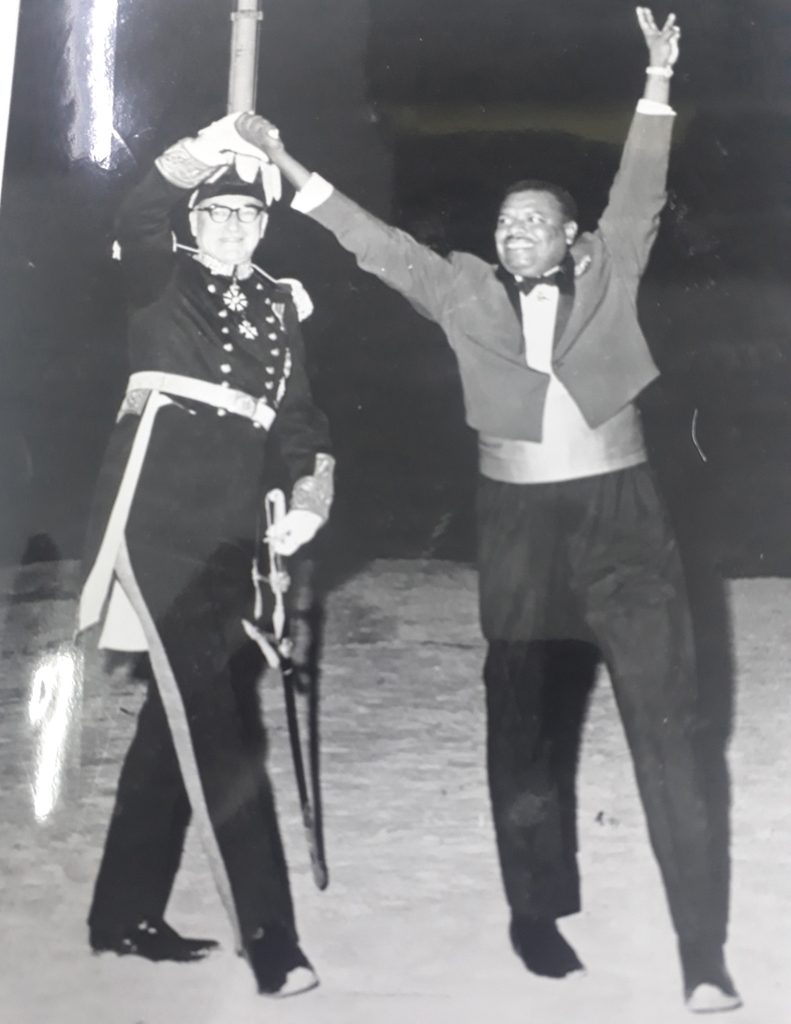
The following day, when the country celebrated its first Independence Day, Stow was named Governor-General. For most Barbadians, the lasting image of him is with late Prime Minister Errol Walton Barrow, both dapperly dressed during that iconic picture at the Garrison Savannah.

Stow held the post until May 18, 1967.

The History of Barbados records him being present with members of the House of Assembly on March 10, 1961 when the SS Diplomat became the first commercial vessel to enter the Deep Water Harbour

He passed away in London at age 85 in March 1997.

Editor’s Note: Barbados is celebrating 60 years as an independent nation and five as a republic.

Prime Minister Errol Barrow was the man of the moment after the Broken Trident was raised and Barbados was declared an independent country. He is being “presented” to the country by Governor General Sir John Stow.

Fogging Schedule: November 2 to 6

0

The Ministry of Health and Wellness’ Vector Control Unit will conduct its fogging programme in parts of St George and St. Michael this week. The team will focus its efforts in St George for the first four days of the week before moving to St Michael.

On Monday, November 2, fogging will be concentrated in the following districts: Eastlynne Road, Eastlynne Tenantry, Buckley Terrace Nos.1, 2, and 3, Connell Road, Good Intent, Benton Cul-De-Sac North and South, Paloma Circle, Sundancer Ring Roads South, East, West and North, Warleigh Avenue, Ellerton Road inclusive of Niles Road, Crawford Road, Sargeant Road, Ruth King Road, Walker Road, Toronto Road, and Lowe’s Road.

The following day, Tuesday, November 3, the Unit will spray Carmichael, Buttals to Plantation, Carmichael Heights, Ellerton Heights, Ellerton Park, Ellerton Housing Area, Waverly Cot Roads Nos.1 and 3, Waverly Cot Development, Brighton, 1st Avenue First Step, Harris Roads Nos.1 and 2, Mahogany Drive (Hillside Heights),1st Avenue Blenmans Road, Blenmans Road and surrounding areas.

On Wednesday, November 4, the team will go into Melverton Avenues Nos.1 to 4, Mount Road inclusive of Mount Gardens, Millfield Road, and Avenues 1 and 2 Drax Hall Jump, Drax Hall Tenantry Road, and 3rd Avenue Windsor.

The Unit will turn its attention to Woodland, George Holligan Road, Greens inclusive of 1st and 2nd Avenues Greens, Drax Hall Hope, James Drax Street, Prerogative, Prerogative Link Road, Wilkinson Road, 1st and 2nd Avenues Bairds Village, Fairview/Bairds Village Road, Ashbury, St. Judes, Rock Hall, Logan’s Road and neighbouring districts on Thursday, November 5.

The fogging exercise for the week will conclude on Friday, November 6, in Hothersal Turning from the roundabout inclusive of Clarke’s Road, Small Land, Academia Estates, Browne’s Gap, Friendship Tenantry, Friendly Hall, Jackman’s Development, Jackman’s inclusive of Skeete’s Road, 1st Avenue Skeete’s Road, Lower Estate Heights, Hothersal Terrace, and Harmony.

Fogging takes place from 4:30 p.m. to 8:30 p.m. daily. Householders are reminded to open their windows and doors to allow the spray to enter. Children should not be allowed to play in the fog.

Members of the public are advised that the completion of scheduled fogging activities may be affected by events beyond the Unit’s control. In such circumstances, the Unit will return to communities affected in the soonest possible time.

German cost-of-living protests turn violent

0

Rioters looted shops in central Frankfurt late on Saturday as clashes erupted in German cities over the cost of living.

Besides Frankfurt – Germany’s financial hub – there were incidents of violence in Berlin, Cologne and Hamburg, with police saying they used water cannon to disperse protesters who were targeting emergency workers with fireworks, stones and bottles.

Thousands joined largely peaceful demonstrations earlier in the day. They were organised by the campaign group Gen Z regelt – meaning “Gen Z takes charge” – to protest against underfunding in schools, the high cost of living, public spending cuts and military service.

The unrest in Germany follows similar youth-led mass protests in France, where more than 320 000 people also demonstrated on Saturday.

On Sunday, Germany’s Interior Minister Alexander Dobrindt told Bild newspaper that overnight police had prevented “violence like that seen in Paris” in recent weeks and called for “harsh punishments” for rioters and looters.

Overnight, a large section of Frankfurt’s main shopping street was closed off by police. A police spokesperson said many arrests were made in the city.

Authorities in Frankfurt, Munich and Berlin reported as many as 18 000 protesters, roughly half of what the organisers had estimated on their website. German media say tens of thousands protested in German cities on Saturday.

Gen Z regelt spokesperson Lina Friedrich said the demonstrations were “to fight for peace and freedom, rather than for war and coercion”.

She said: “What matters most to us is better support for the health and education systems. We are against compulsory military service and we are in favour of a fairer distribution of the burden.” (BBC)

Hanson Hill Road closed due to accident

0

UPDATE: Hanson Hill, St George has been reopened and is now accessible to the public, says the Barbados Police Service.

***

Motorists are being urged to use alternative routes as Hanson Hill Road, St George is impassable due to a traffic collision.

The affected section runs from its junction with Dash Valley Road to Edgerton Road (the road leading to the Blackman and

Gollop Primary School).

King to address slavery during Commonwealth speech in Antigua

0

King Charles III is to speak with “unflinching honesty” and “sincere sorrow” on the lasting pain of the transatlantic slave trade, during the final leg of his Caribbean tour in Antigua, Buckingham Palace has said.

The King will address Commonwealth leaders on Tuesday in a speech which will touch on the issue.

Prime Minister Andy Burnham said earlier he was “open” to the possibility of the UK formally apologising for its role in slavery – a change in the government’s stance.

It is understood the Palace was told in advance of Burnham’s comments in an opinion piece on Friday night, and the King has not made any changes to his speech in light of them.

The British government has never formally apologised for slavery or offered to pay reparations.

Burnham has previously stuck with the policy of his predecessors, and stopped short of offering any consideration of reparation payments.

Conservative Party leader Kemi Badenoch described “endless talk about apologies” as a “distraction” from solving current problems.

She told BBC Sunday with Laura Kuenssberg: “The transatlantic slave trade happened centuries ago. It is time for the Commonwealth to start looking forwards, not endlessly backwards.”

The King will make his speech at the Commonwealth Heads of Government Meeting (CHOGM).

He “will not shy away from confronting the most shameful aspects of the past during this visit”, a Palace spokesperson said.

“You may therefore expect him to address them in his speech with unflinching honesty, sincere sorrow, and respect for the wider discussions that will be taking place between relevant governments on this issue at CHOGM and beyond.”

When asked about the King’s reaction to the prime minister’s comments, the spokesperson said it would “not be appropriate” for the King to address matters of policy relating to “the UK government’s position”.

The Caribbean tour has again thrust King Charles into the difficult debates over the UK’s colonial legacy in the region.

On his first stop in the Bahamas, the King delivered a speech where he spoke of the “suffering of the past”.

In Guyana, he visited the site of a Slave Rebellion where hundreds of enslaved people were killed.

Buckingham Palace said it was a moment for the King to learn more about the history of slavery and resistance. His engagements have also covered the environment, opportunities for young people and trade relationships with the UK. (BBC)

Barbados praised for HIV progress

0

The World Health Organisation (WHO) Friday congratulated Barbados for eliminating the transmission of HIV from mother to child.

It marks a major public health milestone resulting from years of sustained efforts to ensure babies are born free of HIV.

“I congratulate Barbados on protecting a generation of children from HIV,” said WHO Director-General Dr Tedros Adhanom Ghebreyesus. 

“Barbados has shown what universal health coverage looks like in practice: free services for every pregnant woman, regardless of nationality, and care that respects her rights and privacy. 

“With 15 countries and territories in the Americas now recognised, the region continues to show the world the way.”

Minister of Health and Wellness Senator Lisa Cummins hailed the achievement.

“This is incredible for us, and it allows us to be able to see our children living their full, best lives. It allows mothers to be able to have the benefit of treatment during pregnancy, before treatment, but also, it means that we’re able to ensure that we have a healthier population, and we’re able to join the other countries around the globe that have also equally been able to achieve this historic milestone,” she said.

She credited the long-standing collaboration between the Government of Barbados, PAHO/WHO and other partners to strengthen HIV services, surveillance and quality of care for making the achievement possible. 

Barbados now joins a group of 26 countries and territories worldwide recognised by WHO for eliminating mother-to-child transmission (EMTCT) of HIV, syphilis or hepatitis B, or for being on track to achieve it. Fifteen are in the Americas, making the region the global leader
in these achievements. 

Certification by the WHO follows an independent assessment confirming that Barbados met the global targets on elimination of mother-to-child transmission of HIV. From 2022 to 2024, no new HIV infections resulting from mother-to-child transmission were reported among infants born in Barbados.

“Barbados has shown that eliminating mother-to-child transmission of HIV is possible when women and children have access to quality health services without barriers,” said Dr Jarbas Barbosa, director of the Pan American Health Organisation (PAHO) and WHO regional director for the Americas. 

“This achievement means that children are born free of HIV and that women living with HIV can access the care and treatment they need. It is a proud moment for Barbados, the Caribbean, and the global effort to end AIDS in children.”

The assessment found consistently high coverage across the board: 98 per cent of pregnant women received antenatal care, 98 per cent were tested for HIV, and 98 per cent of pregnant women living with HIV received antiretroviral treatment during the three-year period. (BA/PR)

Rich heritage on show through dance

0

By Donna Sealy

Twenty-one of this year’s best dance performances collectively told a story of Barbados’ rich history from slavery, its achievements, its cultural heritage, its belief in God, and the resilience of its people to overcome struggle and achieve their dreams during the CIBC Caribbean NIFCA Performing Arts Dance Finals Friday night.

“One Nation. Many Movements” was the theme of this year’s edition and the audience at the Frank Collymore Hall had lots to applaud and cheer about as dancers added to a tapestry that is still being woven as Barbados’ 60th anniversary of Independence and fifth year as a republic draw closer.

The National Independence Festival of Creative Arts doesn’t only provide a platform for entrants to showcase their talents; it gives audiences opportunities to reminisce and remember what was while showing them what exists presently and what is to come.

Performances such as the impactful speed painting and dance From Chains to Change performed by Thee Art Experience’s Simone Williams, Dancin’ Africa’s mixed-discipline (a dance film) Hard At Work, and Haynesville Youth Club’s Escapism, were reminders of the painful past of slavery, the endurance of the enslaved and the cycle of labour and life.

In From Chains to Change, “a journey of rhythm and resilience”, Williams honoured the bond between heritage and home while highlighting the strides made and how ancestors such as the African-born Barbadian-enslaved woman Nancy Daniels paved the way for leaders such as Prime Minister Mia Amor Mottley. And in the latter two choreographies, there were glimpses of slavery juxtaposed with the modern work life before employees escaped the drudgery of heavy loads to experience fun and freedom, albeit through dreams.

Thanks to Multifarious Dance Crew’s We Gine Town and Dancin’ Africa’s Tales from the Yard the audience was able to take a jaunt to a time when life was perhaps harder but simpler. 

Aboard B246, Multifarious Dance Crew, known for its street and urban movements, took individuals on a nostalgic, entertaining, comical and enjoyable bus ride exploring some of the notable changes and historic moments through Bridgetown such as November 30, 2021, when the county became a parliamentary republic. Through movement, music, images, videos, excerpts from speeches, advertisements for popular businesses, sounds as well as references to familiar people (Blondie was included), the crew’s collage showcased the importance of the capital to the country’s history.

Meanwhile, Dancin’ Africa’s entry harkens back to yesteryear where the backyard was a gathering place for families, neighbours, as they did chores, cooked, talked, and children played games.  

Arah fine arts’ Whispers of the Missing: Threads of Hope brought a sobering situation centrestage, as they delivered a piece that highlighted the unsettling issue of missing children told from their perspective. 

The richness of the nation’s folkloric heritage and culture were ably demonstrated by Bim Cheer Federation in Bajan Circus with ringmaster Anansi the spider, a cast comprising Green Monkeys, Mother Sallies, Steel Donkeys and Bearded Fig Trees who flipped, jumped, and somersaulted, in the piece about togetherness and cultural expression. Haynesville Youth Club also did something similar in the delightful entry Bajan Pelau which showcased tuk music, folk music, plaiting the maypole and Grand Kadooment while the days of Yoruba Yard, the infectious rhythm of the drum, a key part of Africa dance, were contained in the Spirit of the Drum, performed by Dancin’ Africa’s junior troupe. 

The power of the collective, community, belonging and friendship were the central themes of the choreographies from Nawesa Dance Movement (A Harvest Foretold), Dancin’ Africa (Ubuntu:I Am Because We Are), S. Neverson Dance Collective (Zazi Mina), Powerhouse Academy of the Arts (Us) and Queen College’s Sync 5 (No Pressure, Just Fun), testimony to what can be achieved if Barbadians work together towards a common goal.

Working hard, dreaming big, and believing that you can achieve your goals was the underlying message in 17-year-old Kato Austin’s well executed self-choreographed performance. Augmenting his on-stage performance of To Believe with onscreen images from his time at Julliard and other productions, he showed that one’s start doesn’t determine one’s future.

Three entries depicted the theme of struggle: Powerhouse Academy of the Arts’ The Armistice performed by Khyce Belgrave, J.O.Y Productions’ The Dilemma performed by three dancers and Dancin’ Africa’s Of Now. All were emotive and riveting. While the first two depicted internal struggles as the dancers explored whether the love and passion for the art and a strong religious belief co-exist with an individual, the third explored the “emotional landscape and intricate connections that exists” between two people.

And there was praising and celebrating God. Karar Dancers’ Jesus, one of the best of the show in terms of costuming and choreography, did more than highlight some of the pivotal moments of Jesus’ life. It was a reminder of the lyrics of the National Anthem that “God has been the people’s guide” and a proclamation that He is to be exalted which was also evident in Kingdom Living Dance Movement’s Anthems of Reverence and Unveiled Dance Collective in The Harvest.
(GBM)