Sunday, May 31, 2026
Home Blog Page 238

Light Show Protest Ahead of COP11 and Why it Matters for the Caribbean

0

Liza Katsiashvili

Something out of the ordinary was noticed at the WHO’s COP11 venue last week in Geneva. A light show illuminated the building’s walls, urging consumers to be part of the global tobacco control dialogue. The message was clear: the WHO cannot claim to fight for public health while excluding the very people whose lives are at stake.

What’s happening? As COP11 approaches (November 17–22), the WHO and national delegates will meet to decide on tobacco control measures that will affect millions of smokers worldwide, including those across the Caribbean. While the aim of reducing smoking rates is noble, the question raised by the World Vapers’ Alliance’s light projection is unavoidable: how can the WHO achieve positive change while silencing those most affected, the consumers themselves?

The “quit or die” approach has failed everywhere. According to the WHO’s own data, smoking kills over 8 million people each year. Yet, instead of embracing harm reduction strategies that have been proven to save lives, many policymakers cling to outdated, prohibitionist ideas. Substituting deadly combustion with less harmful nicotine alternatives, such as vaping and nicotine pouches, offers smokers a potential path away from smoking-related illnesses.

Why does this matter for Barbados and the Caribbean? While much of the agenda is shaped by powerful interests in larger countries, smaller nations like Barbados have the opportunity, and responsibility, to speak up for their citizens. Caribbean policymakers can call for evidence-based regulation that reflects local realities rather than imported ideology. Including consumers in the conversation means making space for real-life experience, for stories of those who successfully quit smoking through harm reduction, stories that too often go unheard.

Banning or restricting less harmful alternatives would only drive consumers back to cigarettes or into illicit markets. Instead, countries like Barbados can lead by example, adopting pragmatic, life-saving approaches that empower individuals rather than stigmatise and punish them.

The light show in Geneva should remind us that millions of people are ready to be part of the solution. As COP11 begins, let’s ensure that Caribbean voices, especially those of consumers, are no longer ignored.

LLA joins Liberty Caribbean Foundation in sending critical supplies to Jamaica

0

Telecommunications company Liberty Latin America (LLA) joined forces with the Liberty Caribbean Foundation to deliver essential humanitarian and technical supplies to Jamaica in the days following Hurricane Melissa’s passage late last month.

In a statement released on October 31, the company said it coordinated a chartered X-Cargo A321 flight that transported potable water, non-perishable food, hygiene products, flashlights, residential generators, and network restoration equipment from the United States to Kingston, just 48 hours after the hurricane struck.

“This initial delivery was made possible through the extraordinary support of our partners and suppliers,” said Aamir Hussain, Chief Technology and Product Officer at Liberty Latin America. “We extend our sincere gratitude to Wesco-Anixter, EFL, IBC Airways – GlobalX, Starlink, Digicomm, Tarana, and Viavi for their invaluable contributions.”

The shipment arrived in Kingston before dawn, where Flow Jamaica’s local operations team immediately began distributing supplies to the hardest-hit communities.

“The coordination with our Liberty Latin America and Liberty Caribbean team in Miami, supporting as a second command center, has been constant and efficient,” said Stephen Price, Vice President and General Manager of Flow Jamaica. “We have mobilised multiple relief teams across the island and are prepared to continue receiving shipments that will help save lives.”

The Liberty Caribbean Foundation has called on the public and private sector to continue supporting relief efforts. The foundation said donations will go toward food, potable water, emergency kits, and connectivity services for affected families, as well as long-term recovery initiatives in heavily impacted communities. (PR)

I was ‘put in’, fraud tells court

His was a situation that he had been “put in”.

This Content Is Only For Subscribers

Please subscribe to unlock this content. Enter your email to get access.
Your email address is 100% safe from spam!

Salvation Army launches Christmas Kettle Appeal, declares Jamaica Relief Day

0

The familiar sound of the Salvation Army’s Christmas kettles returned to the streets of Bridgetown on Friday morning as the organisation officially launched its annual Christmas Kettle Appeal at Golden Square Freedom Park.

The event, attended by President of Barbados The Most Honourable Dame Sandra Mason, marked the start of the holiday season campaign, which raises funds to support families in need across Barbados and the Eastern Caribbean.

This year’s launch carried a special call for regional solidarity. Major Robert O. Pyle, Divisional Commander of the Salvation Army Barbados and St Lucia Division, announced that tomorrow, Saturday, November 8, will be designated Jamaica Relief Day. All funds raised in Barbados and St Lucia on that day will go toward Jamaica’s recovery efforts following the devastation of Hurricane Melissa.

“In keeping with our theme for this Christmas season, we will lend a helping hand to the people of Jamaica,” Major Pyle said. “We urge the public and friends of the Army to give generously so that others may be blessed. Let us continue to pray for those who have lost their homes, belongings, livelihoods, and loved ones.”

Dame Sandra praised the Salvation Army’s long-standing record of transparency and compassion, commending the organisation for its dedication to the most vulnerable.

“It is evident that the money raised by the Salvation Army goes to the worthy causes it promotes,” she said. “Even if you cannot give as much as large corporate donors, every dollar counts. Six dollars can go a long way in helping someone in need.”

She also reflected on her personal involvement with the charity, through the annual hamper distribution over the past seven years. “Though I will not be in Barbados this Christmas, my heart will be with you,” she added.

Advisory Board Chairman of the Salvation Army, Paul Bernstein, shared that from January to September this year, the organisation served 36 444 meals and planned to distribute 4,800 Christmas food hampers to families in need. Gifts will also be delivered to children’s homes, senior citizens’ residences, and other charitable institutions. He thanked members of the business community for their continued partnership.

Carla Boyce, Manager of Premium Relationship Banking at Scotiabank (Barbados) Limited, reaffirmed the bank’s 70-year partnership with the Salvation Army and its commitment to empowering individuals to rise above their circumstances.

“Every dollar helps make Christmas brighter for someone in need,” Boyce said. “Whether it’s a hot lunch, a food hamper, or a child’s smile, your generosity matters. Together we can help the Salvation Army continue its mission of service and love.”

The Salvation Army’s kettles will be placed at various locations across the island throughout the Christmas season, inviting Barbadians to give and “lend a helping hand” this year.  (AM)

Traffic changes for Remembrance Day Service in Bridgetown

0

The Barbados Police Service has announced several traffic changes for the Remembrance Day Service and Parade on Sunday at the Cenotaph in National Heroes Square, Bridgetown.

The restrictions will be in place from 6 a.m. to 10 a.m.

Upper Broad Street, Trafalgar Street, Wharf Road, Rickett Street and High Street will be closed to vehicular traffic during this period.

Partial closures will also be in effect. No traffic will be allowed from Marhill Street onto the Charles Duncan O’Neal Bridge, and Broad Street will be closed from Prince William Henry Street to High Street.

Motorists are advised to expect delays along Coleridge Street, Magazine Lane, Broad Street, Bridge Street, Roebuck Street and Tudor Street. Vehicles travelling along Lower Broad Street must turn left at Prince William Henry Street.

No parking will be allowed on Belmont Road, Constitution Road, Martindale Road, St Michael Row, Bridge Street, Trafalgar Street, Magazine Lane, Palmetto Street and Rickett Street between 6 a.m. and 10 a.m.

Parking for authorised vehicles will be available at the Parliament Building Courtyard, Marhill Street, Lower Bay Street, Golden Square/Freedom Park, Palmetto Street and Probyn Street.

Anyone who breaches these rules or disobeys an order from a uniformed officer may be fined $500 or imprisoned for up to three months.

These regulations do not apply to emergency vehicles or those operated by the Barbados Police Service, the Barbados Defence Force or the Barbados Fire Service.

Police officers will be on duty to assist with traffic management, and the Barbados Police Service has thanked the public for their cooperation and understanding.

Make ‘people more resilient’

0

One of the Caribbean’s leading economists is urging Barbados and other islands in the region to establish public investment funds and pump more money into initiatives that make people, not just infrastructure, more resilient.

Trinidadian Dr Justin Ram, who is chief executive officer of Justin Ram Advisory, and a former director of economics at the Caribbean Development Bank (CDB), made the suggestion as he argued that the economic model used by Barbados and the wider Caribbean was leaving them “very, very vulnerable”.

“We tend to focus on gross domestic product. We need to accumulate as much foreign exchange as possible so that we can import, primarily. What we consume is actually about 70 to 100 per cent imported. In my humble opinion, you can’t build resilience on that,” he said.

“In that type of economic environment, we are not focused on the human condition and human well-being.”

Ram was delivering a keynote address on the topic Nexus Of Economics And Sustainability on Wednesday on the third and final day of the Caribbean Sustainable Infrastructure Conference 2025 at Hilton Barbados Resort.

The event was hosted by the CDB, in association with the United Kingdom Foreign, Commonwealth and Development Office and the French Development Agency.

Ram recommended public investment funds for the region to “start mobilising a lot more of your own domestic financing, [and] get your people to also be part of that development through their savings”.

“I think that each of our countries can have what I call a public investment fund. And that fund can initially be financed through some of the foreign exchange reserves that we have,” he suggested.

“Money [would be] put in by our governments . . . encouraging savings by individuals and domestic firms into that public investment fund. And that fund then has the mandate to invest on the country’s behalf, investing in the projects that make sense, but investing in the projects that also provide an economic and financial return for the persons who have placed their money there,” Ram

said.

“I think the time for us to start mobilising more domestic resources with the . . . technical assistance from places like CDB . . . has come, because there is no longer going to be sufficient funds from external sources for us.”

He added: “I know Prime Minister Mia Motley has spoken about it many times. How do we mobilise domestic savings for our development? So instead of perhaps saving our foreign exchange reserves and treasuries . . . overseas, why not take some of those resources and help finance our public investment fund and then crowding other investors into that for our development?”

Ram noted that “over the last few years, my thinking on economic development and certainly on sustainability and resilience has changed tremendously”.

“We are still so vulnerable. Almost every year, one of our countries is hit with some type of catastrophe. And just last week, of course, we saw . . . Jamaicans suffering from that terrible Hurricane Melissa,” he said.

Ram called for a new economic paradigm instead of the existing one which said “rising consumption equals economic growth, and we’re happy with that”.

He also asserted that economists had lost their way because “we don’t focus enough on the human condition, we focus on macro indicators”.

“But what’s really happening on the ground? I think that it’s time for us to focus our sustainability and resilience efforts on the human condition, human well-being, thinking about what sustainable production means for that,” he said.

“Inclusive growth, environmental care, of course, because that’s critical for us and . . . building resilient communities. In my humble opinion, I think that’s the true meaning of economic success for our region.” (SC)

Ann Hill dishes out best in breadfruit

0

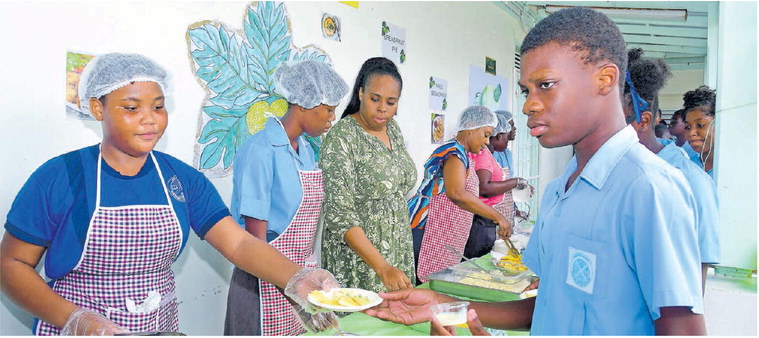
To show the importance and versatility of breadfruit, the Ann Hill School hosted its Breadfruit Day on Tuesday.

Under the theme Feeding the Future, the event, held at the school, coincided with International Breadfruit Week, which was celebrated from November 1 to 7.

Students and staff traded their books and pencils for kitchen utensils as they worked tirelessly to prepare various dishes from breadfruit under the guidance of home economics teacher Faith Griffith. Served up was pickled breadfruit, breadfruit casserole with salt fish, breadfruit punch, fried breadfruit, breadfruit potato salad and breadfruit pie.

The school was transformed into a breadfruit extravaganza as the walls showcased a variety of breadfruit dishes and original breadfruit art pieces and decorations designed by the school’s staff and students who stood in line to sample some of the dishes.

Gain culinary experience

Griffith said the objective of the event was to give students a culinary experience that showed them how to prepare a meal despite financial situations.

The students who helped prepare the dishes for Breadfruit Day were part of a special group selected by the school, many of whom showed great interest in culinary arts and were passionate about the kitchen.

In the future, Griffith said she hoped to see those students working within the industry.

“These students that you see here, hopefully will go on to work within the hotel sector, the restaurant sector, as

they participate in our school-towork programme. Hopefully, you’ll be seeing some of their faces in your restaurants in the years to come,” she said.

Enjoyable process

Student Soriyah Clarke-Gray said she spent two days preparing for the event with direction from the home economics teacher. She said the preparation process was enjoyable, adding she would continue to push herself to achieve her goals. She said her favourite dish to prepare was the fried breadfruit.

Ashanti Patterson, who has a deep love for cooking, was another student who helped prepare the breadfruit dishes. She said her love for cooking made the experience a memorable one and she was elated when she was selected among other students to prepare dishes for event.

“It was good to learn how to cook and I would be happy to learn more about cooking and do more recipes,” she said enthusiastically.

Jay Clarke, another student who also helped prepare some breadfruit dishes, said he helped to prepare the breadfruit punch.

(AJ)

Study on offenders paints ‘troubling picture’

0

A new study on young offenders on remand at Dodds Prison has painted a troubling picture of how early exposure to violence, substance abuse, family instability, and weak school engagement are fuelling Barbados’ youth crime problem.

Senior Research Officer at the Criminal Justice Research and Planning Unit (CJRPU), Kirt Goodridge, yesterday revealed the findings during a workshop at the Courtyard by Marriott.

He said the study, which examined 47 inmates aged 16 to 25, showed a combination of factors has been propelling young men toward violent offending from as early as primary school.

“These young men are not simply waking up one day and committing crimes. There are risk factors that lead to this outcome, and we can see them early on; it’s about recognising and intervening before they escalate,” Goodridge said.

Serious offences

According to the research, 98 per cent of the cohort were male, with the majority aged between 19 and 25. They had been on remand an average of five years, mostly for serious offences – 53 per cent for murder, 28 per cent for firearm possession, and nine per cent for robbery. More than two-thirds had prior convictions, with 40 per cent previously incarcerated and 68 per cent arrested before. The average age of first conviction was 18, though many had come into contact with the juvenile justice system earlier.

“Fifteen of the inmates exhibited deviant behaviour before the age of 11,” Goodridge said, explaining that many had passed through the Government Industrial School or Juvenile Liaison Scheme before graduating to more serious offences.

Drug use

Drug use was almost universal among the group. Eighty-nine per cent used marijuana, often daily, starting as early as nine years old.

Alcohol use was also common, with 64 per cent admitting to regular drinking from around age 16. Smaller numbers reported using molly (17 per cent), cocaine (9 per cent), and ecstasy (4 per cent).

“These early habits normalise substance use and lower impulse control, making violent or risky behaviour more likely. Many were introduced to drugs by friends, which shows the strength of peer influence,” he added.

The findings also linked school exclusion to later criminality. A staggering 83 per cent of inmates did not complete secondary school, most leaving around

age 15, many after repeated suspensions for fighting.

Thirty per cent were expelled outright, while others dropped out or were superannuated. Six schools accounted for the majority of attendees – St George Secondary, Parkinson Memorial, Princess Margaret Secondary, Frederick Smith Secondary, St Leonard’s Boys’, and Graydon Sealy Secondary. “Suspension and expulsion for fighting are early signs. If these are not addressed, it escalates from fists to rocks to knives and eventually guns,” the Goodridge noted.

Employment outcomes reflected this disruption. Fortyfive per cent held unskilled jobs such as construction labourers, 19 per cent were unemployed, and only 10 per cent had at least one CXC certificate. “These are young men entering precarious, low-paying work, often frustrated and unable to sustain themselves, which increases vulnerability to crime,” he said.

The report underscored that 66 per cent were raised by female caregivers, primarily mothers or grandmothers, with limited father involvement. While most reported their mothers as present, 30 per cent said their fathers were absent altogether. Over half of the inmates had at least one incarcerated family member, with many fathers, brothers, or uncles previously jailed for violent crimes such as murder and firearm offences.

“Many grew up seeing relatives use violence to solve disputes. That normalises violence as a way of resolving conflict,” Goodridge said. Even in communities described as “peaceful,” 63 per cent of inmates reported witnessing violence, including shootings and murders. He warned that focusing solely on punishment would not solve the problem. “We must change the culture that glorifies imprisonment and gang life. Teachers, parents, and communities can all spot the signs early.

What we need are systems in place to respond before another young man ends up behind bars,” he said.

( CLM)

CCRIF to make another multi-million dollar payment to Jamaica

0

The Cayman Islands-based Caribbean Catastrophe Risk Insurance Facility Segregated Portfolio Company (CCRIF SPC) Thursday announced that it is making a second payment of US$21.1 million to Jamaica following the devastation caused by Hurricane Melissa last Tuesday.

The CCRIF SPC, which is the Caribbean and Central America parametric insurance facility and development insurer, said the funds had become available after Jamaica has triggered  its excess rainfall parametric insurance policy.

On October 31, CCRIF  SPC announced that Jamaica would receive a payout of US$70.8 million based on the country’s country’s tropical cyclone policy and as a result, the total payouts to Jamaica from CCRIF amount to US$91.9 million  as a result of the devastation caused by Hurricane Melissa.

The CCRIF SPC  said earlier this week, it  provided the Jamaica government with a portion of the tropical cyclone policy payout, estimated at eight million US dollars  to provide immediate access to quick liquidity.

It said the remaining US$62.8 million will be paid by November 13t,  in keeping with CCRIF SPC’s key value proposition of making payouts within 14 days of an event.

It said the excess rainfall policy payout will also be made within 14 days, following final model verification. Excess rainfall assessments typically take a few days longer than tropical cyclone evaluations due to the complexity of rainfall distribution and localized impacts.

CCRIF SPC’s  chief executive officer, Isaac Anthony is due to visit Jamaica to meet with senior officials to discuss how the company can provide further assistance for the country’s recovery efforts and how it can support the government in further enhancing its financial protection strategy.

It said the CCRIF SPC’s parametric insurance policies are a key component of Jamaica’s comprehensive disaster risk financing strategy and that payouts provide its members with immediate access to liquidity to support vulnerable populations, repair critical infrastructure, stabilise public services such as water, and reduce the country’s economic exposure, safeguarding debt and fiscal sustainability targets and overall development gains.

Jamaica currently has coverage for tropical cyclone, excess rainfall and earthquake.

Prior to the two payouts for Hurricane Melissa, Jamaica received three other payouts in previous years on its tropical cyclone and excess rainfall policies for Tropical Cyclones Beryl, Eta and Zeta. (BBC News)

Church hoping to halt ‘moral decline’

1

Churches and citizens who share deep concerns about the moral decline in Barbados will be coming together on Sunday to host an open forum on some of the burning issues affecting the country.

Family-Faith-Freedom, Barbados will stage the event from 4 p.m. at First Baptist Church on Constitution Road, St Michael.

Speaking with members of the media yesterday, Pastor of First Baptist Church and group member Paul Leacock said some of the key indicators of social collapse could be identified in the rising crime and indiscipline within the education system.

“We are seeing wanton murders that defy explanation, and when we are seeing our young men being cut down and murdered in the streets by other young men, that’s a major loss to our country at all levels. Not only are we reducing our population of productive men, but we are robbing families of fathers, of sons, brothers, and key members of that society and our nation as a whole,” Leacock said.

In the face of these social ills, the pastor added that Government had failed in its approach to addressing these matters, noting the proliferation of guns, while drug use had increased among the youth.

“We are concerned that the policies of Government have not borne fruit. And therefore the citizenry of this country continues to be exposed, not only to the murders, but to the reprisal of the families of victims, and others, who many times are taking the law into their own hands,” he said.

Toll on families

This cycle of retaliation and violence, Leacock said, exacted a heavy toll on the families of victims who were left to bear the emotional and financial burden of the loss of life.

“That is a serious problem that’s going to manifest in generationally, especially when you have young children who have witnessed their parents being killed.

“I can tell you here at this church, many times we have to teach children principles – who are themselves consumed with either anger or trauma – because their parent was gunned down sometimes in front of them,” he said.

Another concern he raised related to what he described as an “anti-church attitude”, noting that organisations such as Family-Faith-Freedom, Barbados were often unwelcome in discussions of the issues affecting the country.

Leacock said many of the problems could be traced to missteps in the education system, charging that the Ministry of [Educational Transformation] had ushered in a standard of indiscipline with changes to grooming policies and what he said was the reduced authority of teachers.

“We can go from the uniform to the hairstyles to the various restrictions that have been placed on teachers and principals, who are complaining that they have been reduced of their authority and power and yet they have to maintain the educational standards, which we clearly are seeing in severe decline.

“We are concerned that the ministry has not been a proper guardian of moral values that would maintain what we know from the past has helped the last generation to be upright students, citizens, achievers,” he added.

Adding to these sentiments, Pastor Carl Barker, of Shalem Evangelical Church, said this indiscipline was disturbingly shown in recent displays of aggression that was sometimes directed towards teachers.

He believed these maladaptive behaviours were symptoms of Barbados’ shift from Christ-like values and the loss of positive faith figures in the lives of children, especially young men.

“We have a lot of angry men around Barbados because they’re hearing about fathers, but they’ve never had a relationship with them. And all of this happens because the country has decided that we don’t want God anymore. We can fix everything from climate change to crime, but have we done it? That is the question,” he said.

The pastor hoped that the rally would address these and other matters, noting that the aim was not just to discuss but to find solutions to the country’s ills.

(JRN)