Home Blog Page 35

MP urges faster maintenance hearings

0

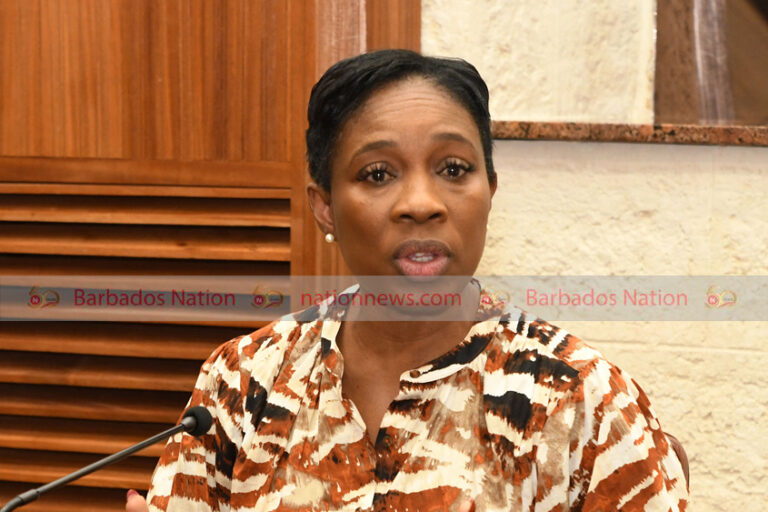
Christ Church South Member of Parliament Dr Shantal Munro-Knight has appealed for improvement in the way child maintenance matters are handled in the Magistrates’ Court system.

She told the House of Assembly yesterday she was continually receiving complaints from young women who come to her constituency clinic expressing “frustration and hurt” at the way they are treated within the system and the untenable delays in getting action on their cases.

“This issue of justice and how people experience justice and their interface with our court system is one . . . that we have a responsibility [to] get right as much as possible. This is the issue of child maintenance and the multiple delays within the Magistrates’ Court system.”

She said there were women who had to take time off work; find someone to take care of their children if they were not in school; and forced to sit in the court for many hours, with nobody saying anything to them, only to be subjected sometimes to repeated adjournments of their cases. Munro-Knight, who is also Minister of Agriculture, Food and Nutritional Security, raised the issue during debate on the Magistrates’ Court (Amendment) Bill

piloted by Minister of Legal Affairs and Criminal Justice Michael Lashley. The legislation proposes to bring virtual hearings to the Magistrates’ Court, just as obtains in some instances in the High Court.

Munro-Knight contended that very often the matters which come up before the Magistrates’ Court were “matters for the average Bajan, for women and young girls as well, who need to be able to come to the court and depend on the court”.

She pointed out that during the COVID-19 pandemic, it was accepted that matters of the court in some respects could be handled online, but regretted that “all of a sudden, COVID has passed us, we have forgotten and therefore now again we retreat to what is traditional and known, rather than taking the lessons that we have learnt about the way that technology and virtual hearings can still serve as a critical asset and enabler for the court system”.

She said while it was accepted that Barbados could have large pieces of legislation which were over-arching and important, “unless we attempt to address those things that the average people deal with every day, then the impact of our governance will not be felt as strongly at it should be”. (GC)

Global tensions ‘driving up costs’

0

Until geopolitical issues, including wars in major international markets that are vital for the production and transportation of important commodities are resolved, Barbadians will face cost of living pressure even as Government continues to cushion the impact of rising prices.

That is the reality, says Minister of Finance Ryan Straughn, who has returned home from the International Monetary Fund (IMF) and World Bank annual meetings in Bangkok, Thailand, where he raised these concerns with the international community.

In its latest outlook, the IMF is projecting that consumer prices in Barbados will increase by 2.6 per cent this year, while international credit rating agency Fitch expects inflation “to remain around two per cent in the near term, with the potential for it to rise”.

The Central Bank will give an updated inflation figure at its third quarter economic review next week, but reported in June that inflation was 1.4 per cent at the end of May and predicted it would increase to between two and three per cent “in the near term”.

Inflation measures the rate at which prices rise. A lower percentage does not signal a decline in prices, but that they are increasing at a lower rate.

“One of the issues that I raised over there [in Bangkok] with the authorities was that if the world continues to try using what I describe as market policy instruments to resolve what are really geopolitical issues, then we will continue to see this cost of living pressure increase globally,” Straughn told the MIDWEEK NATION.

“And certainly Barbados, we’ve done all the right things in terms of reform and trying to get our economy back in shape, but these decisions that are being taken by the developed countries, whether it is through wars, whatever it is, continue to create stress for countries like ours.

“So until . . . the geopolitical matters are resolved, so that the genuine demand and supply of the market will be back in place, then we’re going to continue to see these cost of living issues.”

The minister said cost of living concerns were evident in Europe and the United States, noting that “it has always been a part of our feature because of the nature of how we rely logistically on Miami and the like for a lot of what we do.

“And once the tariffs went into place, then obviously it just accelerated the impact, especially post-COVID,” he said.

“So in the short to medium term, until those geopolitical things are resolved, we will continue to see these cost of living pressures build. It’s unfortunate because Government could only absorb as much as we can and still maintain the delivery of public services that we want to deliver for the public.”

Diversify import sources

Straughn had hoped that by now the private sector’s efforts to diversify its import sources would have achieved more success, as he observed that Miami remained a major source of supplies.

“Regrettably, as some in the private sector have seen, some movement in terms of seeking alternative sources of not just goods but alternate routes to get the goods into Barbados, it hasn’t been as swift as we would like, because we are still relying pretty much on the ease and the convenience that we built with respect to the logistics out of the port of Miami,” he said.

“And so, I think we really must make sure then that once the Government will continue to do what it can, the private sector equally has to be more proactive in relation to making a difference in relation to where they get stuff from and investing in other productive ventures.”

He added: “Now, I think equally, the use of monetary policy to solve geopolitical issues also continues to create challenges because it just means that your cost of financing for projects and for the private sector globally will increase at a time when, naturally, you really need to be much more accommodating.

“But the solution to the geopolitical issue is really the key thing because as you well know, once prices go up, they don’t likely come back down as quickly, if at all. Whilst fuel prices generally do fluctuate, other prices, generally speaking, don’t adjust by the same magnitude.” (SC)

Minor among two remanded on theft and firearm charges

0

A 22-year-old St Philip man and a juvenile charged in connection with robbery and use of a firearm, were both remanded to Dodds Prison when they appeared in court today. 

Izaia Micah Worrell, 22 years, of Duncuns Link Road and the unnamed male juvenile, were jointly charged with two counts of use of firearm on October 10 and 12; and three counts of robbery – one on October 10 and two on October 2.

Worrell was separately charged with possession of a firearm on October 17.

The pair was not required to plead to the indictable charges and Magistrate Bernadeth John, sitting in the District ‘C’ Magistrates’ Court today, remanded them to reappear on November 17. (PR/SAT)

Police renew appeal for wanted Nigerian man

0

Police have issued a fresh appeal for anyone who may know the whereabouts of Nigerian national Chidi Uzomba who is wanted in connection with a serious criminal matter.

Uzomba is about six feet in height, dark complexion, medium built and has a tattoo of a human face on his left arm. 

He is advised that he can present himself to any police station accompanied by an attorney of his choice.

Anyone who may know the whereabouts of Chidi Uzomba is asked to contact the Police Emergency at 211, Crime Stoppers at 1 800-8477 or the nearest Police Station. (PR/SAT)

Barbados Accreditation Council pushes to improve qualification system

0

The Barbados Accreditation Council (BAC) continues to work with Government as it advances the development of the Barbados Qualifications and Credit Framework, but recognises that more has to be done.

Executive director Lisa Gale, addressing a two-day workshop at the Lloyd Erskine Sandiford Centre, Two Mile Hill, St Michael, said their role was more important than ever.

“This is not only an important activity, but an important step towards a more coherent, transparent, and accessible qualification system. It will provide a common structure for classifying qualifications, clarifying their levels and learning outcomes, and facilitating greater comparability across education and training. This importance also lies in the opportunities it can create for learners at all ages and stages. Education is no longer confined to a particular stage of life or a traditional sequence of qualifications, and we know this. Individuals must be able to acquire new competencies, build upon prior learning, pursue alternative pathways, and adapt to changing labour market demands.

“Our national qualifications framework is intended to support these ambitions by facilitating recognition of prior learning, improving progression opportunities, and strengthening connections across academic, technical, and vocational education and training. My team and I have been working diligently to complete the remaining foundational elements necessary to advance the framework’s development. However, we recognise that a qualification framework is not enough,” she said.

Gale said that while the framework would establish how qualifications were classified and related, it was a robust accreditation system which would provide assurance regarding the quality of the institutions and programmes through which those qualifications are delivered, which was where the BAC shone.

“These are distinct but complementary mechanisms, both essential to building confidence in our education and our training system. The National Qualification Framework also presents an opportunity for institutions to critically examine their programmes, particularly their learning outcomes, qualification levels, progression pathways, and relevance to national development priorities. For Barbados, these developments have significant implications. As a small island developing state, our competitiveness is closely tied to the knowledge, adaptability, and capabilities of our people. We must therefore be deliberate in developing an educational training system that supports lifelong learning in response to emerging technical opportunities, emerging economic opportunities, and preparing individuals for an increasingly complex environment, among other things,” she said.

Gale encouraged the workshop participants to engage fully and question some of the established practices, challenge assumptions and share experiences, adding the diversity of institutions, countries, and professional perspectives present created a valuable opportunity for mutual learning. (CA)

Mother forfeits $50 000

She lost one son six years ago and the other one, who was recently convicted of that son’s death, caused her to lose $50 000 yesterday.

This Content Is Only For Subscribers

Please subscribe to unlock this content. Enter your email to get access.
Your email address is 100% safe from spam!

Italian linguist’s book explores Barbados’ unique sayings

0

Italy-based linguist Dr Cristiano Furiassi published his book, Bajanyms: Toponymic Idioms in Barbadian English and Bajan, at the Barbados Museum.

The event was attended by members of the University of the West Indies, the Barbados Library Service and the Richard and Jeannette Allsopp Centre for Caribbean Lexicography.

Furiassi said the book contained four chapters, with the final chapter listing 41 idioms. He said the book examines place names and sayings in Barbados and Panama and their links to history, adding that Barbados’ language was unique and showed the resilience of its people.

Power hike concern

0

Questions and concerns are being raised about the fuel-related hike in electricity costs which Barbados Light & Power Company (BLPC) says is causing its residential customers to pay at least $22 more this month.

The scrutiny from Barbados Consumer Empowerment Network (BCEN) and others came as Minister of Finance Ryan Straughn indicated that Government was continuing measures intended to give Barbadians an ease on their electricity bills.

Last week BLPC announced that the Fuel Clause Adjustment (FCA) paid by customers had increased by 19.8 per cent for October because of “continued volatility in international fuel markets and higher fuel-related electricity generation costs”.

This related especially to the cost of aviation jet fuel which, unlike heavy fuel oil, was not benefiting from the fuel hedging arrangement being undertaken by the Barbados National Energy Company Limited (BNECL) and had “experienced significantly larger price increases than heavy fuel oil” during the past six months.

Reacting yesterday to news of the higher electricity bills, BCEN executive chairman Maureen Holder urged BLPC to provide more clarity on the $22 increase, saying that consumers deserved full information about the FCA and related matters.

This included “a clear breakdown of the announced increase of approximately $22 in the average residential electricity bill for October 2026, following a reported 19.8 per cent rise in the FCA.

“BCEN acknowledges that international fuel prices affect electricity costs. However, consumers deserve to know how much of the increase reflects fuel price changes and whether other charges contribute to the adjustment,” Holder said.

“This question matters because, on October 29, 2024, the Fair Trading Commission (FTC) approved the recovery of rental and operating costs for 11 megawatts of temporary Aggreko generating capacity through the FCA.

“BCEN is not claiming that these costs explain the current increase. We are asking whether they remain in the adjustment, under what approval and at what cost to consumers.”

Holder stated: “BCEN calls on Barbados Light & Power to disclose the contributions of heavy fuel oil, aviation fuel, purchased electricity and any temporary generation costs. “The company should also explain how fuel-hedging arrangements have protected consumers and identify any previous balances being recovered. Consumers also need clarity about the FCA smoothing mechanism.

“Deferring charges may limit an immediate increase without reducing the total amount payable. BLPC should disclose how much has been deferred, when recovery is expected and the potential effect on future bills,” she added.

Straughn, who said he saw news of the FCA-related electricity bill increase in the NATION while he was attending the International Monetary Fund and World Bank annual meetings in Bangkok, Thailand, pointed out that the Budgetary Proposals announced in March to give Barbadians an electricity cost ease were continuing.

This fuel hedging tool allows Government, through the BNECL, to lock in the price of heavy fuel oil used by BLPC to generate electricity, and absorb 50 per cent of the increase in the FCA on electricity bills above the March 2026 bill at a cost of $7.9 million.

These measures were initially for three months, but the minister said they were still in place, as was value added tax on electricity bills being kept at 7.5 per cent for the first 250 kilowatt hours for residential homes from April 1, until March 31 

next year.

Since the measures were announced in the Budget, the FTC approved BLPC applications related to the company’s use of additional temporary generation units, as well as for the pre-approval of it utilising equipment called synchronous condensers, decisions which Straughn alluded to yesterday.

“The BNECL, I think we are in the fourth fuel hedge now, and so we continue to protect Barbadians as much as we can,” he said.

“Now I do know that there were some issues related to producing the electricity which they [BLPC] had gone to the Fair Trading Commission for and was granted, which is outside of what we had programmed when I announced in the Budget. So the Budget measures continue, and obviously the matter relating to [the FTC] is outside of the arrangement we had put in place in March.”

Straughn also noted that during the course of the period there was a shift based on maintenance of some of the turbines. 

“So they [BLPC] had to start using some of the other fuel, which obviously, as you would appreciate, is going up [in price]. But that really ought to have been a temporary thing, and that’s all the more reason why, whilst we are doing what we are doing on the heavy fuel oil, we are pushing to get the battery solution in place by the end of next year, so that the volatility associated with prices then will no longer be
as significant as it clearly is at the moment,” he said.

Ricky Went, an intervenor in regulatory matters before the FTC, was also concerned about rising electricity costs, including in the context of interim rates being paid to BLPC and its expected new rate application early next year, as indicated recently by the FTC.

“In essence, the cost of living is high and hurting everyone. The less fortunate is over-burdened. Yes, it is accepted that cost has risen and some areas are outside of our control, but collective effort is needed to ensure everyone can get the basic needs,” he stated.

His view was that in order to find a balance, one consideration could be that entities like BLPC “should be prepared to accept
lower rates of return”.

Mum followed rules, but still got no justice

0

Alisha Sargeant said she was just nine years old when a boy struck her in the left eye and kicked her in the chest in Queen’s Park, The City. 

Today, she is 25 and says the boy who attacked her seems to have vanished; the school she once attended turned a blind eye, and the High Court case meant to deliver her justice has never gotten off the ground.

Alisha and her mother, Gale Sargeant, are lamenting that the last 13 years have been a masterclass in systemic failure – a gruelling journey through a legal maze that exhausted their finances, compounded their trauma and left them staring at an empty courtroom.

“I got no justice,” Alisha says, her voice breaking with emotion that has fermented over more than a decade and a half.

“It affected me greatly. Even still up to this day, now that I’m a mother, it still affects me greatly.”

The incident remains etched in Alisha’s memory, but it was not an isolated one. For a time, she told the Sunday Sun, she was repeatedly bullied by that boy. Gale sadly recalls the many times her daughter came home from school complaining that the boyand his friends had beaten her, taken away her lunch, and even thrown her school bag over the fence.

Gale said she went to the school management many times. One day, furious after receiving a call that the boy had injured her daughter, Gale went to the school with a friend, afraid her emotions would get out of control, but said the reception she received was chilling.

“I said, ‘I come about the incident about this child beating my child all the time’. The principal looked at me and said, ‘Get her from my desk. Get her from my desk’.”

Gale went to the police. They listened, but the next day, the bullying continued. Left with no other choice, she pulled her daughter out of the public school system and placed her in a private school, even though it was a crushing financial blow.

“I had to pay school fees. I used to get a line of credit to help pay. I had to pay for hospital visits. I had to pay for medical reports. I not only suffered physically, but emotionally and financially.”

But a few months later, as fate would have it, her daughter and the boy would meet again as their individual schools gathered for sports in Queen’s Park. It was February 4, 2011. He wandered over to Alisha’s side of the grounds.

“I can recall him coming over,” Alisha remembers.

“He struck me in my left eye. He had a spray can or something in his hand, and he knocked me in my eye and he also kicked me in my chest as well.”

Gale remembers the call she received that her daughter had been injured. She managed to get to the Park where she saw Alisha lying on the ground bleeding, surrounded by teachers, police and students. She admitted she lost it, especially when she realised it was the same boy she thought she had finally gotten her child safely away from.

“I was really looking to kill somebody that day,” Gale admits, the raw emotion still palpable.

“My limbs felt heavy. I couldn’t move. I got on bad. I was screaming, ‘How could you let this happen to my child’?”

She also stormed into the offices of the nearby Ministry of Education, but again, she left feeling let down by the response.

Gale said her daughter was traumatised and even afraid to go to school. She added neither the Ministry of Education nor the school offered counselling. It was only after a colleague heard Gale lamenting at work that she was directed to Supreme Counselling. 

Alisha also remembers crying almost every day, the trauma deeply embedded. Even a chance sighting of her attacker years later on Baxters Road, The City, triggered an immediate surge of anger.

Determined to hold the responsible parties accountable, Gale did what the system demands: she sued. She brought a lawsuit before the High Court against the boy and his father, the Ministry of Education, the school and the Attorney General.

But then, the real nightmare began.

With no money to pay a lawyer, Gale, who once worked in a law firm, used what little knowledge she had and filed the lawsuit herself. However, she was later summoned by a judge who informed her that her filings were incorrect and suggested she get an attorney. She managed to scrape together $5 000 and went to a recommended lawyer.

Then came the revolving door of the judiciary. The case bounced from one judge to another and then to two Masters of the Supreme Court. Even more disturbing was her inability to get in touch with her attorney. Gale pointed out that he moved offices several times, and at one point, she unexpectedly received an $8 000 bill from a legal firm informing her that her attorney had joined them and they had taken over her matter. Gale insists her attorney never communicated this transition to her.

To make matters worse, the boy they sued seemingly disappeared. Reports from 2018 indicate police issued a missing person’s report on him, and rumours suggested he had died.

Two weeks ago, Gale met with a court official who informed her that the case may no longer proceed through the court.

Gale is angrier now than she was the day she got the call from the Park – especially now that she has discovered her daughter was entitled to legal aid assistance, a right that was never communicated to her.

Alisha looks back at a childhood she said was derailed by violence and a legal system that offered nothing but adjournments.

“When it comes to frustration, it’s like, am I going to get justice? It hurts me very, very, very much.”

Gale refuses to let her daughter’s story be buried in a backlog of court files. She is speaking out because she believes the system is sending a dangerous message to the next generation.

“We are telling society that you could do anything and through loopholes, people can get away with this nonsense,” she said.

“Therefore, you’ve got a society where people are very angry because of no justice. What more should I have done as a mother? I went through the proper channels.”

For Alisha, now navigating the anxieties of motherhood herself, the lack of closure is a heavy feeling she still cannot shrug off. The boy who struck her in the Park may be gone, but the system that failed to catch him is still very much intact.


Griffith’s life of service lauded

0

President The Most Honourable Jeffrey Bostic and Prime Minister Mia Amor Mottley were joined by parliamentarians, senators, diplomats, members of the consular corps, senior figures in the Public Service, family and friends yesterday, in saying farewell to a man who gave 49 years of his life to public service in Barbados.

The official funeral for Erskine Griffith, who died September 8 at the age of 86, saw scores turning out at St Patrick’s Anglican Church in Christ Church, where Griffith was a lifetime member, for the two-hour service.

The late resident of Spring Farm, St Philip, served as a Minister of Agriculture and Rural Development; a Leader of Public Business in the Senate; as Barbados’ first Permanent Representative to the United Nations and other international organisations in Geneva.

Delivering the eulogy on behalf of the family, Orville Wiltshire spoke about values such as “hard work, integrity, critical thinking, humility, respect for others and the community”, which were instilled in Griffith’s upbringing and which informed his professional life.

Educated at Modern High School, Griffith began his career as a clerical officer at the Government Industrial School in 1959, followed by stints at the Customs, Auditor General’s and the Accountant General’s departments and the Ministry of Home Affairs.

He joined the Ministry of Finance and Economic Affairs in 1973, where the eulogist said he “found his calling, serving finance for 27 years until the year 2000”.

Wiltshire also shared about Griffith’s  academic exploits which saw him securing a bachelor of arts degree in economics and history, and a diploma in public administration from the University of the West Indies, and later, a master of science  in financial studies from the University of Strathclyde in Glasgow.

Wiltshire said Griffith constantly sought out opportunities for continued education over the course his career, “to enhance his knowledge and ensure that he was bringing the most up-to-date ideas and implementations to his work on behalf of the country”.

Griffith served under six Ministers of Finance – the Barbados Labour Party’s Tom Adams, Sir Harold St John and Owen Arthur, and the Democratic Labour Party’s Errol Barrow, Sir Richard Haynes and Sir Lloyd Sandiford.  

Wiltshire described Griffith as “an absolute professional”, noting that “in spite of staunch support for the Barbados Labour Party throughout his career, his balance was a testimony to his dedication to putting country before political affiliation.

Griffith’s service was recognised by Government in 1995 with the national award of the Gold Crown Of Merit. 

His widow Winifred, to whom he had been married for 62 years, sat stoically as their sons, Dr Rean Griffith and Haydn Griffith, read
the lessons.

The service was conducted by rector of St Patrick’s, Reverend Nicholas Small-Warner, while the Rev. Angela Phillips delivered
the Homily.

Interment took place in St Patrick’s churchyard.