Home Blog Page 91

Rubio says Cuba is threat to US as Havana accuses him of ‘lies’

0

Cuba poses a “national security threat” to the US and the likelihood of a peaceful agreement is “not high”, US Secretary of State Marco Rubio has said.

His comments come just a day after the US charged Cuba’s former president Raúl Castro with murder over the 1996 downing of two planes resulting in the killing of US nationals.

Rubio said Washington’s preference was “a diplomatic solution” but warned that President Donald Trump had the right and obligation to protect his country against any threat.

Cuba’s Foreign Minister Bruno Rodríguez accused Rubio of “lies” and said the island had never posed a threat to the US.

Speaking to reporters on Thursday, Rubio said diplomacy “remains our preference with Cuba”, but added: “I’m just being honest with you, you know, the likelihood of that happening, given who we’re dealing with right now, is not high.”

He also accused Cuba of being “one of the leading sponsors of terrorism in the entire region”, which Rodríguez vehemently denied in a post on X.

The Cuban foreign minister criticised Rubio for trying to “instigate a military aggression” and accused the US government of “ruthlessly and systematically” attacking his country.

Cuba is suffering from a fuel crisis exacerbated by an effective US oil blockade, while under pressure from the Trump administration to make a deal.

Its citizens have experienced extended blackouts and food shortages over the last few months.

Rubio said the country had accepted a US offer of $100m (£74.4m) in humanitarian aid.

Trump has repeatedly sought to exert pressure on Cuba and has openly discussed toppling its communist regime.

The US has demanded political and economic reforms but the specifics are unclear beyond a leadership change. They could include a pledge to open up the economy to more foreign investment and a commitment to end the presence of Russian or Chinese intelligence agencies on the island.

Wednesday’s indictment of the former Cuban president is seen by some as reminiscent of Trump’s seizure of Venezuelan President Nicolás Maduro in January.

Asked by reporters whether – and how – his government would get Castro to the US to face the charges, Rubio replied: “I’m not going to talk about how we’re going to get him here, if we were trying to get him here, why would I say to the media what our plans are about that?”

Acting Attorney General Todd Blanche, who announced the charges in Miami on Wednesday, said the US “expect he will show up here, by his own will or another way”.

Rubio is the child of Cuban immigrants who left the island prior to the 1959 Cuban revolution. He represented Miami, with its large Cuban exile community, in the Florida state legislature prior to becoming a US senator for the state.

He speaks fluent Spanish and, because of his upbringing and rise in Florida politics, has deep ties to the state’s Cuban-American population.

On Thursday, Rubio also announced on X that the US had arrested Adys Lastres Morera, the sister of one of the top officials of a Cuban military-run conglomerate that controls most of the lucrative parts of the country’s economy.

Morera was living in Florida “while also aiding Havana’s communist regime”, Rubio alleged. She was arrested by immigration enforcement and will remain in custody pending deportation proceedings.

Speaking to reporters in the Oval Office, Trump said Cuba was a “failed country” and that his administration was trying to help them “on a humanitarian basis”.

He said Cuban-Americans “want to go back to their country” and help Cuba succeed.

“Other presidents have looked at this for 50, 60 years doing something and it looks like I’ll be the one that does it, so I would be happy to do it,” Trump said. (BBC News)

Mystery of missing caskets

0

Who took the caskets of a deceased funeral director?

The mysterious disappearance of five caskets is part of an unfolding domestic drama following the death of funeral director Ian Griffith over the weekend and as funeral arrangements are being made for him.

A social media post rapidly making the rounds this week evoked chuckles and glib comments from those who saw the request for information leading to the recovery of the “stolen” funerary boxes.

It followed the death of Griffith, 62, of Civilian Road, Bush Hall, St Michael who died on Saturday at the house where he lived and crafted the boxes which were also on display in the showroom of the property.

A relative said that on Wednesday five of the seven caskets that were on display went missing prompting a report to police and a public call to be on the lookout for the coffins.

The business, Shar-Ian’s Funeral Services, a combination of Griffith and his daughter’s name, was closed yesterday when the Weekend Nation team turned up.

However, the public notice said the caskets were missing from the showroom and was being treated as theft. The notice stated anyone with information on where the items were should “come forward immediately”. It also listed a WhatsApp number for Sharian Griffith.

“Any help would be deeply appreciated,” the notice stated.

The relative said they felt sure they might know who the culprit was that took the caskets but was puzzled as to where they could be stored. ( AC)

‘Soil the cause of brown sea water’ at Carlisle Bay

The source of brown sea water spreading across Carlisle Bay remains in question as both beachgoers and environmental scientists have disputed that ocean and climate-related factors are the cause.

In a Letter to the Editor, Professors Emeritus Dr Julia Horrocks, Dr Robin Mahon and Dr Hazel Oxenford, at the Centre for Resource Management and Environmental Studies, disputed the claims made by director of the Coastal Zone Management Unit, Dr Leo Brewster, last week.

Throughout recent weeks, concern has mounted among residents and beachgoers after the water across Carlisle Bay appeared brown, resulting in closure to swimmers over the weekend.

In an exclusive interview with the Sunday Sun, which appeared May 17, Brewster said that the phenomenon, referred to as “green water”, normally occurred between February and mid-April but arrived unusually late this year. He attributed it to delayed freshwater flows from the Amazon and Orinoco Rivers in South America, which created unusually high water levels around Barbados.

He said that this disrupted the beaches’ normal recovery period after the winter swell season. The director also dismissed that the issue was being caused by increased coastal development, saying: “There’s none, It’s island-wide.”

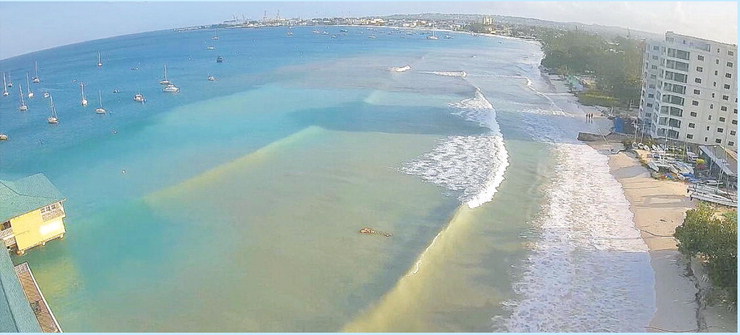
In a response to the article, the scholars indicated through photographs derived from live satellite images under the IWCP camera streams that the brown water emanated from the Fort Carlisle condominium block on Burkes Beach and was first detected as a brown plume of soil from the development site.

“This eight-storey concrete building is constructed on the ‘living beach’, despite space on the land side that would have allowed it to be set back even beyond the legal limit of 100 feet from the high-water mark. Had the developers set the property back further, the recent high swells would not have washed the soil, brought in for landscaping the site, into the sea.

“Since April, this soil has been leaching from the site every high tide, forming a brown water plume in front of the building that has been clearly visible on publicly accessible webcam footage, culminating in the high swell event over last weekend on May 16,” the letter read.

It noted that while Barbados regularly receives pools of lower salinity “green water”, they would be unusual so early in the year and would not result in water the colour of what was revealed in the photographs and what appeared on Carlisle Bay.

On Wednesday, the Weekend Nation visited the site of the nearly completed Fort Carlisle development, where a foreman confirmed that last Saturday, high sea swells resulted in the landscaping soil being drawn into the sea.

“The weather came in and pushed down everything. We had some soil in there and [the sea swells] came in higher than expected and just took everything inward. When the environmental people came in, we just moved all the equipment,” he said, confirming that all landscaping was paused until the go-ahead from the environmental officials as well as Town and Country Planning.

A frequent beachgoer to the area and swimming instructor who opted to remain anonymous said that for the past two weeks he had seen the high surf carrying the mud from the condominium on the coastline onto the beach, leaving a scent of cement.

“The high surf came in and it dragged all of that dirt because it went all the way up into the hotel, along with another property next door that is doing some dredging as well. That pulled all of that mud into the sea and there was a strong scent of cement on the water as well.

“For quite a few days, nobody was going into the water. Then on Saturday you had a whole heap of lifeguards on the beach telling you don’t go in the water because it’s this and it’s that. They don’t know what it is. There were supervisors and two beach wardens checking the same area, and they went immediately to the area where it was coming from,” he added.

While the environmental professors noted that beach erosion and the effects of global warming on corals remained a pressing concern, the local sources of stress on the country’s reefs were a problem that could be directly mitigated.

“If new developments are appropriately set back, there is no need for the protective hard structures like sea walls and boulders, which themselves exacerbate beach erosion, and also less chance of soil being washed into the sea,” the letter read.

(JRN)

Murder accused: Didn’t mean to hurt her

It was never his intention to hurt anyone, said murder accused Roger Delisle Sealy.

This Content Is Only For Subscribers

Please subscribe to unlock this content. Enter your email to get access.
Your email address is 100% safe from spam!

Government announced new measures for entry into Antigua and Barbuda

The Antigua and Barbuda government has announced new measures aimed at enhancing public health safety amid concerns regarding the deadly outbreaks of Hantavirus, Ebola and Malaria in several parts of the world.

The Trinidad-based Caribbean Public Health Agency (CARPHA) Thursday said that following the declaration by the World Health Organization’s (WHO)  that the Ebola Virus Disease (EVD) has now  become a public health emergency of international concern (PHEIC), it assesses that the current risk to the Caribbean region is low.

“Despite the low risk, CARPHA is urging its member states to maintain a high state of readiness. Because the Caribbean is a major global travel hub, the primary way the virus could arrive is through an infected traveler,” said Dr. Lisa Indar, CARPHA’s executive director.

“ CARPHA provides a layered, yet proactive approach to early warning, supporting member states in the early detection, verification, and response to emerging health threats,”  she added.

“ The declaration of a PHEIC underscores the need for heightened international and regional vigilance and coordination. CARPHA continues to monitor this outbreak closely through its global scanning early warning mechanisms.

“Additionally, CARPHA leverages its integrated suite of regional early warning and surveillance tools to support timely detection and situational awareness. These include event-based and indicator-based surveillance systems with early warning alerts, such as the Tourism and Health Information System (THiS), the Caribbean Vessel Surveillance System (CVSS), national syndromic surveillance through the District Health Information System (DHIS) and the Talkwalker social listening platform. ”

A statement issued following the weekly Cabinet meeting, noted that Health, Wellness, the Environment and Public Service Affairs Minister, Michael Joseph, had advised that the ministry has been closely monitoring developments relating to several international health threats.

He said that the Ministry of Health has already commenced the process of upgrading the operations of the Port Health Unit to facilitate enhanced monitoring and surveillance protocols at the ports of entry.

Among the measures to be implemented are expanded health screening procedures, including temperature testing and enhanced traveler monitoring systems designed to identify potential public health risks before entry into Antigua and Barbuda.

“Cabinet was advised that incoming travelers will also be required to disclose details of their travel history over the previous 21 days. This measure will allow health authorities to determine whether individuals may have traveled through countries where any of the identified viruses are currently prevalent and to ensure that the appropriate health protocols and precautionary measures are implemented where necessary.”

The statement said  that the ministry is undertaking preparatory work to ready the Infectious Disease Centre as a precautionary measure to ensure that the country remains adequately equipped to respond swiftly and effectively should the need arise.

Director General of Communications, Maurice Merchant, speaking to reporters, said the changes are expected to become visible from this weekend at air and seaports, adding officials will be drawing from their experiences in managing the COVID-19 pandemic.

“As you would have seen and heard in the news, this is of concern to all countries around the world,” Merchant  said, noting that the World Health Organization has classified the Ebola situation as a serious international concern.

Merchant said regarding the Infectious Disease Centre it remains in a state of readiness but requires some level of restoration after portions of the building were being utilised for storage.

“It would need specialised treatment to ready it, cleaning, etcetera. There was some storage that was being done there, so storage of medical equipment and medical supplies, they will be removed and (the facility) ready to carry out the functions that it was intended for.”

The enhanced monitoring also coincides with the planned launch of the twice-monthly commercial service to Antigua and Barbuda bythe Nigerian-based airline Air Peace, scheduled to begin on Monday.

But Merchant told reporters that while the service had been scheduled months in advance, the evolving health situation in parts of Africa reinforced the need for increased vigilance at the ports of entry here. (CMC)

Maloney Group buys bulk of BICO shares

The Maloney Group has scooped up the majority of shares in ice cream manufacturer BICO Limited.

Businessman Mark Maloney, executive chairman of the Barbados-based investment and development enterprise, confirmed this yesterday and said his group was committed to investing, modernising and expanding the company which also owns and operates the country’s largest cold storage facility – located at the Bridgetown Port.

Longstanding executive chairman Edwin Thirlwell, who is 90 years old, recently retired from BICO, ending a more than 30-year relationship with the company. Reports indicate that Thirlwell sold his shares to the Maloney Group.

Maloney announced in a statement from the group that it has “amalgamated its interests with BICO’s existing shareholders, with The Maloney Group emerging as the majority holder”.

The group said that the combination “opens a new chapter for BICO, supporting accelerated growth, operational excellence and regional expansion”.

It added that the amalgamation “pairs BICO’s heritage, brand strength and customer loyalty with the Maloney Group’s operational depth, capital and regional reach”.

“BICO will adopt advanced systems and best-practice management drawn from across the group’s portfolio – reducing costs, lifting productivity and building a more resilient, scalable business,” the group shared.

“This is a proud moment for the Maloney Group and a powerful endorsement of BICO’s heritage and future potential.

Long-term success

“By combining our shareholding with that of the existing owners, we are committing to BICO’s long-term success – investing, modernising and expanding, while preserving everything that makes the brand special,” Maloney said.

BICO general manager Audley Grimes also commented on the change in majority ownership.

“Mark Maloney’s experience across real estate, finance, hospitality, manufacturing and infrastructure will provide invaluable strategic guidance,” he said.

“Together with our continuing shareholders, this combination will help us unlock new levels of innovation, efficiency and market reach, and deliver outstanding benefits for our employees, customers and stakeholders.”

The Maloney Group said that combined ownership was “expected to support geographic expansion beyond Barbados, product diversification, and continued investment in talent and technology, while attracting further high-quality investors to fuel BICO’s growth”.

Established in 1901, BICO is a publicly listed company, with its shares trading on the Barbados Stock Exchange. Its 2025 annual report listed shareholders with more than five per cent of issued common shares.

Minority shareholders own equity

These were Nordev One Limited (555 809 shares), Windsong Investments Limited (469 852), Nordev Two Limited (225 366), Sagicor (Equity) Fund (172 235), and Bajan Vending Inc. (119 882). There are also a number of minority shareholders who own equity in BICO.

The change in the controlling interest of BICO, which was founded in 1901, comes more than three years after the Fair Trading Commission (FTC) denied a proposed sale to Trinidad and Tobago’s HADCO Group, owner of Creamery Novelties Limited, on the grounds that the merger would “result in a substantial lessening of competition”.

BICO argued then that it was competing against at least 30 ice cream brands sold in Barbados, and that Chefette Limited’s entry into the market with its Frosteez brand was now its “major competitor”. Thirlwell had also warned prospective buyers that following the FTC’s denial, there would be no “fire sale” of BICO.

With the Maloney Group now in control, sources said BICO staff were anxious to get details on the company’s future direction and leadership following Thirlwell’s departure, whose tenure included the construction and commissioning of a new manufacturing plant after the previous one was destroyed by fire.

In BICO’s 2025 annual report, Thirlwell said on behalf of the directors that the last financial year ended September 30, “was marked by volatility, as anticipated, with heightened competition across our core ice-cream market segments”.

The company recorded a seven per cent increase in revenue, but incurred a $317 188 loss, which the directors’ report attributed mainly to “persistently high energy costs, which are projected to increase further, and the escalating cost of imported inputs”.

Published statement

BICO’s published unaudited income statement for the second quarter ended March 31, reported that the company’s revenue, including the Harbour Cold Store, was $4.3 million, up $573 592 over the same period last year, but there was a net loss of $147 853 compared with a $282 237 profit in the same quarter in 2025.

BICO’s distribution, administration, and engineering expenses increased by a combined $465 031 in the quarter.

However, on a half-year basis, the company earned a $192 959 profit in the first six months of financial year 2026, down from the $271 430 netted in the first six months of financial year 2025.

Half-year revenue from sales and the cold store was $8.76 million, a $1.16 million increase over the same six month period last year, based on the income statement. (SC)

Man charged after cannabis seizure valued at $312 000

Update

Marvin Selwyn Walcott, 50-years-old, of Bamboo Road, St Lawrence, Christ Church was charged with possession of cannabis, trafficking cannabis and intent to supply cannabis, following an incident on May 15, 2026. Police said the suspected cannabis weighed approximately 78 kilogrammes, with an estimated street value of $312,000 Barbados currency.

He appeared before Magistrate Bernadeth John in the District ‘C’ Magistrates’ Court on today and was not required to plead to the indictable offences and was remanded to the Barbados Prison Service (Dodds).

He is scheduled to reappear in the District ‘C’ Magistrates’ Court on Friday, May 29.

****

Earlier Story

The Barbados Police Service has arrested and formally charged 50-year-old Marvin Selwyn Walcott of Bamboo Road, St Lawrence, Christ Church in connection with drug-related offences.

This Content Is Only For Subscribers

Please subscribe to unlock this content. Enter your email to get access.
Your email address is 100% safe from spam!

Twenty-five Years of Awareness, Education, Hope

For 25 years, the National Wellbeing & HIV Commission has stood at the forefront of Barbados’ fight against HIV championing awareness, prevention, education, support and hope.

Since its establishment in 2001 as the National HIV/AIDS Commission, the organisation has helped shape a stronger, more compassionate national response through partnerships, community outreach, behaviour change campaigns and support services for people living with HIV. From iconic public education initiatives to behind-the-scenes community support, the Commission has remained committed to reducing stigma, promoting healthier choices and improving lives across Barbados.

Today, the National Wellbeing & HIV Commission, continues to evolve through recognising that true wellbeing extends beyond healthcare to include emotional, social, financial and community wellness. As we celebrate 25 years of impact, we honour the people, partners and communities who have helped drive this journey towards a healthier, more informed and more inclusive Barbados.

Read more in the special anniversary feature in the Weekend Nation.

#NWHC #Barbados #25YearsStrong #Wellbeing #HIVAwareness

DLP warns crime could threaten Barbados’ tourism image

The Democratic Labour Party (DLP) is warning that Barbados’ worsening crime situation could begin threatening the island’s tourism industry following the recent attack on a visitor near Savvy on the Bay at Bay Street, St Michael.

“To have it spill over now where tourists are actually being affected and we are having violent crimes occurring where there is tourist activity on the beach, especially, is a great cause of concern,” said Senator Ryan Walters during a press conference on crime this morning at the Errol Barrow Gallery, George Street, St Michael.

Over the weekend, a 25-year-old visitor was reportedly attacked by a group of men near Savvy on the Bay after attempting to retrieve a chain that had allegedly been snatched from his neck. The visitor sustained head injuries and bruises and was treated at the Queen Elizabeth Hospital.

Walters noted that Barbados recorded 49 murders in 2024 and 48 in 2025, while 2026 was already averaging roughly one killing per week and currently stands at 25. He warned that the country risked developing a negative reputation internationally if violent crime continued rising.

“We start to get a bad reputation in the industry because of our murder rate that has increased rapidly over the last couple of years,” he said.

While acknowledging that tourism arrival numbers remained strong, Walters cautioned that crime could eventually undermine the sector if left unchecked.

“The statistics show that we are still performing well . . . but the reality is that the crime situation can also have a scaling down of those arrivals, especially coming into the new season,” Walters warned.

The DLP Senator argued that greater youth intervention programmes, internships and community engagement initiatives were urgently needed to help steer young people away from criminal activity. (Colville Mounsey)

NHC forecasts below-normal Atlantic hurricane season for 2026

0

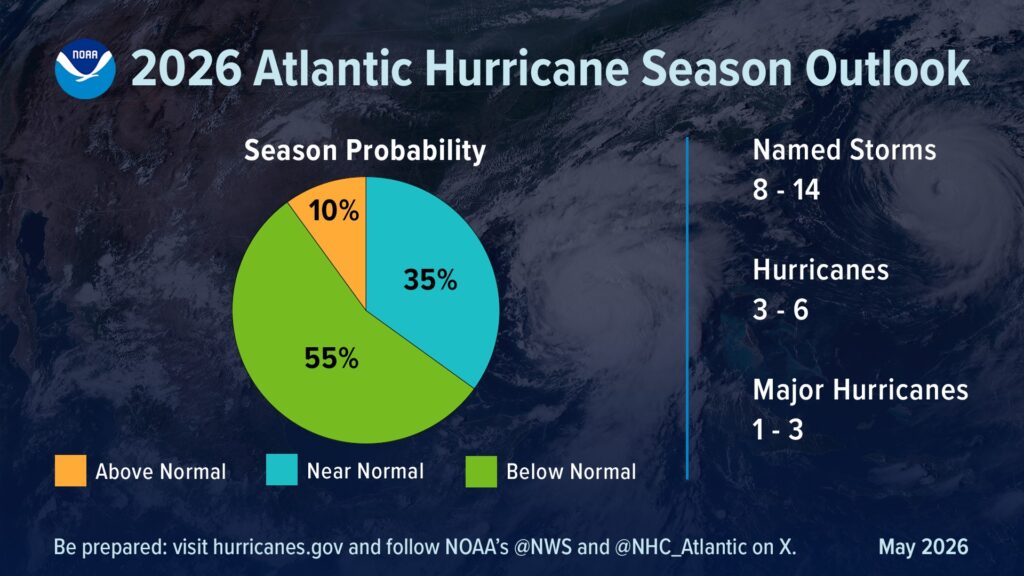
The National Hurricane Centre (NHC) is predicting a below normal Tropical Atlantic Hurricane Season in 2026.

Forecasters say this should be in the range of eight to 14 named storms, with three to six expected to become hurricanes, including one to three developing into major hurricanes. An average season has 14 named storms with seven hurricanes, including three major hurricanes.

The National Oceanic and Atmospheric Administration (NOAA) has a 70 per cent confidence rating in these predictions. There is a 55 per cent chance of a below normal season and a ten per cent chance of it being above normal.

A number of contrasting factors – including the development and intensification of El Niño, as well as slightly warmer ocean temperatures and weaker than average trade winds – are all expected to contribute to this. El Niño conditions tend to support less tropical storms and hurricanes, while warmer ocean temperatures and low winds support a more active year.

“Although El Niño’s impact in the Atlantic Basin can often suppress hurricane development, there is still uncertainty in how each season will unfold,” said NOAA’s National Weather Service Director Ken Graham. “That is why it’s essential to review your hurricane preparedness plan now. It only takes one storm to make for a very bad season.”

The Centre is relying heavily on its equipment, which has integrated Artificial Intelligence models.

The Tropical Atlantic Hurricane season runs from June 1 to November 30.

The named storms for 2026 are: Arthur, Bertha, Cristobal, Dolly, Edouard, Fay, Gonzalo, Hanna, Isaias, Josephine, Kyle, Leah, Marco, Nana, Omar, Paulette, Rene, Sally, Teddy, Vicky, and Wilfred. (PR/SAT)