Home Blog Page 68

West Indies Women finish top-of-the-table to claim series

0

 West Indies Women emerged victorious in the Evara Tri-Nation T20I series after the final match between Ireland Women and Pakistan Women was abandoned without a ball being bowled here on Thursday.

Both West Indies and Ireland ended on 10 points from their four matches after winning two matches, losing one and having one ruled a no result.

However, the Windies Women claimed the series by virtue of having a better net run rate (NRR). They ended with a NRR of 1.839, while Ireland had a NRR of -1.171.

The Windies began the series in impressive fashion by comfortably defeating Ireland and Pakistan in their first two matches, before surprisingly losing their third match against Ireland by one run via the Duckworth/Lewis/Stern method, while the fourth match on Wednesday against Pakistan was rained out.

A win for Ireland in their final match against Pakistan on Thursday would have seen them win the series. However, it was not to be as persistent showers at Castle Avenue saw the match being abandoned.

Pakistan finished the series winless and at the bottom of the table after losing two matches, with the other two ending in no-results.

The result should boost the West Indies Women’s confidence ahead of the start of next week’s Women’s T20 World Cup, which will run from June 12 to July 5.

The West Indies Women’s first match will be against New Zealand on June 13. (CMC)

BWU raises concerns over AI

0

A senior Barbados Workers’ Union (BWU) official is warning that artificial intelligence (AI) and platform-based employment are rapidly transforming the world of work and could leave workers vulnerable unless stronger protections are put in place.

Speaking at the 114th Session of the International Labour Conference in Geneva, Switzerland, BWU Communications and Information Manager Cheyne Jones said the rise of AI-managed labour was no longer a future concern but a reality already affecting workers around the globe.

“The boss is a notification. The workplace is an app. The payslip is an equation. The disciplinary hearing is a blank screen that says, ‘account deactivated’,” Jones told delegates.

He argued that the platform economy, which includes app-based services and gig work, has become the testing ground for AI-managed employment and warned that the same model could soon spread across wider sectors of the economy.

“If we get this wrong there, it will not stay there,” he said.

Jones noted that studies suggest onequarter of global employment is potentially exposed to generative AI, with even higher rates among women and workers in developed countries.

Bringing the issue closer to home, he pointed out that services account for about 86 per cent of employment in Barbados, meaning any major shift in how service industries operate could have farreaching consequences

for workers and families.

“This is not only a technology issue. It’s a rent issue. A food issue. A gender issue. A youth issue. A national resilience issue,” he said.

Jones warned that workers can now be managed by companies located overseas, rated by customers they never meet and disciplined by algorithms they cannot challenge.

He recalled a recent conversation with an Uber driver in Miami who expressed concerns about the growing presence of self-driving vehicles and the uncertain future facing drivers.

He stressed that workers were not opposed to innovation and noted that the union itself had embraced opportunities to train workers in AI technologies.

However, he argued that technological advancement must not come at the expense of workers’ rights.

“Flexibility without security is precarity,” Jones said. “A contract label cannot erase daily subordination.”

He called for greater transparency in algorithmic decisionmaking, human review of serious workplace decisions, stronger privacy protections, labour inspections with access to relevant information and international standards capable of protecting workers in the digital age.

“We cannot accept a future where workers are classified by contract, controlled by code, and abandoned by law,” he said.

“Either rights follow the worker into the algorithm, or the algorithm writes the future without us.” (NS)

Xi Jinping to meet Kim Jong Un in rare visit to North Korea

0

China’s president Xi Jinping will meet Kim Jong Un next week in a trip to North Korea, in his first visit in nearly seven years, according to both countries’ state media.

Xi will be in North Korea from 8 to 9 June at Kim’s invitation. Xi last visited Pyongyang in 2019.

The visit comes weeks after Xi received US President Donald Trump and Russian President Vladimir Putin in Beijing – two countries that loom large over Pyongyang’s foreign policy.

China is a key economic and political partner of North Korea, which faces sweeping international sanctions as a result of its nuclear weapons programme and alleged human rights violations.

China and North Korea share a 1,400km-long border and are bound by a defence pact – the only one China has with any country. It guarantees mutual support if either is attacked.

This year marks the 65th anniversary of that treaty.

For Kim, the propaganda value of Xi’s visit is self-evident. North Korea had improved itsstanding on the world stage after withstanding the pandemic and entering the war in Ukraine on the side of Russia.

Despite Beijing’s close ties with both Pyongyang and Moscow, Xi is wary of the burgeoning alliance between Kim and Putin.

But Beijing, Pyongyang’s largest trading partner, remains the main lifeline for Kim.

It is widely expected that Kim will seek more trade over the land border and more Chinese tourists to fill its newly built beach and ski resorts.

Kim has been proudly displaying his nuclear and missile arsenal. He has also been showing off the capital Pyongyang to visiting dignitaries. And he wants the world to know that it was all achieved without bending his knee to the US or engaging with the South.

Since Kim declared the end to reunification efforts with the South in December 2024, he had called South Koreans a sworn enemy and had cut all levels of communication with Seoul.

Seoul’s attempts at rapprochement appears to have not resonated with Pyongyang.

When the North Korean women’s professional football team visited South Korea last month to face a South Korean football team, the freeze-out was in full display.

The North Koreans barely acknowledged the South Korean public who showed up to welcomed them at the airport and the stadium. They coldly shook hands with the South Korean players before the match then followed with rough and aggressive play.

Seoul is hoping Xi will play a mediator in this trip, nudging Pyongyang to resume dialogue with both Seoul and Washington.

South Korea’s minister of unification Chung Dong-young said he believes that during Xi’s meeting with Kim he will discuss resuming the US-North Korea talks.

North Korea’s sanctioned nuclear weapons programme may also be on the table.

While Beijing is a long-standing promoter of denuclearisation of the Korean Peninsula, it has significantly toned down this position in recent years.

During the Trump-Xi meeting last month, the two leaders reaffirmed the shared goal of denuclearising North Korea, according to a White House fact sheet of the meeting.

But when asked about this at a press briefing, a Chinese foreign ministry spokesperson did not directly confirm the agreement, instead saying China’s position on the issue has maintained “continuity and consistency”.

Pyongyang, for its part, has made it clear that it will not steer away from its nuclear ambitions.

Just this week, Kim said North Korea’s “weapons-grade nuclear materials production capacity more than doubled” in the past five years, as he toured a new nuclear facility, state media reported. (BBC News)

More dust on the way, warn scientists

0

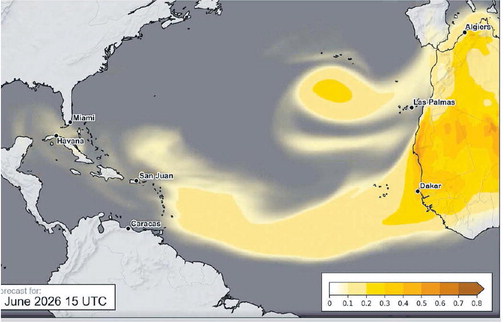
Although the thick plume of Saharan dust that blanketed Barbados over the weekend has moved away from the island, international atmospheric scientists are warning that additional dust could reach the region in the coming days.

Mark Parrington, senior scientist with the Copernicus Atmosphere Monitoring Service (CAMS), in an exclusive with this newspaper said the dust event that affected Barbados forms part of a much larger trans-Atlantic phenomenon that stretched thousands of miles from the west coast of Africa to the Caribbean basin.

The plume was tracked by CAMS (Copernicus is the European Union’s Earth Observation Programme), using satellite observations and atmospheric modelling, with data showing significant impacts across the Lesser Antilles, Puerto Rico, Cuba, Haiti, the Dominican Republic, Jamaica and the Cayman Islands.

“Our latest forecast shows that most of the plume has already cleared Barbados, but dust is still continuing to cross the Atlantic and more could be reaching the island this weekend and into next week. It does look as though the concentrations could be lower than the most recent plume,” Parrington said.

While the hazy skies that blanketed Barbados sparked concern among residents, Parrington noted that the event itself was not unusual by regional standards.

Main concerns

“The size of the plume and concentrations of dust are consistent with dust plumes we have monitored reaching the Caribbean over past years,” he said.

One of the main concerns associated with the dust plume is the increased concentration of PM10 particles, microscopic airborne particles capable of penetrating the respiratory system.

“Our forecasts, particularly of PM10 concentration at ground level, have been showing high concentrations reaching the Caribbean region and resulting in degraded air quality,” Parrington said.

“PM10 represents all particulate matter with an average diameter of less than ten microns, which means they can affect people who suffer from asthma and respiratory illnesses.”

Although CAMS does not directly assess health impacts, Parrington said its forecasting systems could identify areas where dust concentrations exceed internationally recognised air-quality guidelines.

He explained that differences in the severity of impacts between Caribbean islands often come down to geography and atmospheric circulation.

“The relative impacts across the islands will be due to their locations relative to the wind patterns that are bringing the dust to the Caribbean,” he said.

The Barbados Meteorological Services (BMS) first alerted the public to the approaching plume on May 29, when it was located about 1 375 kilometres east of Barbados.

At the time, forecasters anticipated the highest concentrations would arrive on June 1, and reduce visibility to around ten kilometres.

However, updated modelling prompted the BMS to issue a Significant Dust Haze Advisory on May 30, after projections showed the plume would arrive earlier than originally expected.

Thick plume

By May 31, meteorologists reported that a thick plume of Saharan dust was affecting the island and warned that concentrations would increase further overnight into Monday.

Residents, visitors and marine users were advised to expect reduced visibility and possible respiratory difficulties, especially those already suffering from breathing problems.

Visibility across Barbados and its coastal waters was still forecast to fall to around ten kilometres or less during the peak of the event.

Although conditions improved on Monday and the advisory was subsequently discontinued, health officials had already begun urging Barbadians to take precautions.

Four days before the dust arrived, the Ministry of Health and Wellness issued a public warning advising residents to prepare for a deterioration in air quality.

President of the Barbados Association of Medical Practitioners, Dr Lynda Williams said the current event appeared more extensive than many previous dust outbreaks.

“As we can see, it’s far more coverage with the dust than we have seen even in the past,” she said.

Williams urged asthma sufferers not to wait until symptoms developed before taking action.

“What I would encourage, especially those who have asthma, is to make sure that you use your maintenance steroid inhalers, if you have been prescribed one by a physician.

“For those who have been prescribed nasal sprays, this is the time to use them regularly. Then you will have much less possibility of having rhinitis and sinusitis triggered by the dust.”

Scientists are still studying whether Saharan dust events affecting the Caribbean are becoming more frequent or intense, but Parrington said no definitive conclusions have yet been reached.

“We haven’t yet performed an analysis along these lines with our data, but it is something we are planning to do,” he said.

He added that the relationship between climate change and Saharan dust transport remains complex and is still being examined by researchers.

“The role of climate change and different modes of climate variability have different impacts in terms of how much dust is generated from the Sahara,” Parrington said.

“There may also be some impact on the wind patterns across the Atlantic but it isn’t something we have analysed ourselves.”

However, for Parrington, the event highlights something larger than dust itself.

“The long-range transport of plumes such as this gives a clear indication of how people on opposite sides of an ocean can be connected through the atmosphere. In CAMS we are able to provide information on this by using satellite observations and stateof- the-art modelling,” he said. (NS)

Bermuda mourns the death of Sir John Swan

Bermuda is mourning the death of Sir John Swan, the island’s longest serving Premier.

Premier David Burt said, “Sir John dominated Bermuda’s politics for a generation and for over a decade served as Premier of Bermuda. His tenure was historic and those of us who have followed him in this office still feel the shadow of his larger-than-life presence.”

Premier Burt continued, “Our politics often saw us on opposing sides, but we were united in a love of this Island, and her people. Sir John’s “common touch” remains a hallmark of his life and legacy. Whether in the White House or at Cup Match, he was the same man…true to his beliefs and ideals and always ready to greet people with his characteristic warmth. He certainly ‘walked with kings’ but never lost the common touch.

“On behalf of the Government and People of Bermuda I express our heartfelt prayers for the comfort of his children and his family. The legacy of this patriarch is a story of humble beginnings, dogged determination, business and political skill and success, founded in a genuine heart for service.”

The Cabinet Office confirmed that flags on Government buildings will be flown at half mast starting Friday, 5th June. His official biography said, “Sir John Swan was a real estate developer, philanthropist, and the longest-serving Premier of Bermuda. He was widely respected for his keen political and business insight, matched by his humility and gentlemanly demeanour. As a child, Sir John was visually impaired and had dyslexia. His parents instilled in him the importance of discipline and sacrifice, which he embraced fully. He learned to overcome obstacles through determination and a belief in his ability to succeed, principles that have guided his life’s work.

“In 1962, he founded the John W. Swan Agency, a real estate development and savings and loan company offering services in architecture, construction, land development, rentals, and property management. Between 1968 and 1978, the company developed 40% of Bermuda’s residential homes. His mission was to help ordinary Bermudians achieve home ownership and provide them with the financial tools to do so. The company also employed over 20 young Bermudian contractors, many of whom went on to launch successful businesses of their own. The firm celebrated its 50th anniversary in 2012.

“Sir John helped modernize the City of Hamilton through numerous building projects, including Bermuda’s first condominium complex and the island’s first 10-storey development at 141 Front Street, an environmentally sustainable and energy-efficient landmark.

“Before entering politics, he played a key role in national development as a founding member of the Bermuda Monetary Authority, a Director of the Bermuda Chamber of Commerce, and a Director of the Bermuda Employers Council.

“He was elected to Parliament in 1972 and simultaneously became Chairman of the Bermuda Hospitals Board. Over his 25-year political career, he held several important Cabinet posts, including Minister of Marine and Air Services, and Minister of Immigration and Labour, where he introduced progressive policies that supported Bermuda’s economic and social growth. In 1982, Sir John became Premier of Bermuda, a position he held for 13½ years until 1995.

“His most lasting political achievement was leading the negotiations for the 1985 USA – Bermuda Tax Convention. These high-level discussions included meetings with the President, Vice-President, Secretary of the Treasury, Secretary of State, National Security Advisor, and members of Congress. The resulting agreement helped establish Bermuda’s reinsurance and insurance sectors and secured the island’s reputation as a major offshore financial centre, laying the groundwork for the strong, regulated economy Bermuda has today.

“Sir John has been honoured numerous times for his service. In 1990, he was knighted by Her Majesty Queen Elizabeth II as a Knight Commander of the Order of the British Empire (KBE) and appointed a Justice of the Peace. He has received awards from the Bermuda Jaycees, the International Association of Lions Clubs, the Poor Richard Club of Philadelphia, and St. Paul’s AME Church. He was also admitted to the Freedom of the City of London, made an Honorary Member of the Hamilton Rotary Club, appointed a Senator of the Junior Chamber of Commerce, and inducted into the Company of Honorary Fellows of Bermuda College. In 2010, he was one of the first four inductees into the Bermuda Business Hall of Fame.

“He earned a Bachelor of Arts from West Virginia Wesleyan College, which also awarded him an Honorary Doctorate. He received additional honorary doctorates from Atlantic Union College, the University of Tampa, and Morris Brown College.

“Sir John served as Chairman of the Swan Group of Companies and remained actively involved in international business, public policy, and real estate development, including his long-time advocacy for the revitalization of the Hamilton Waterfront. He passionately supported local charitable causes and was a patron of Bermudian theatre for more than three decades.” (Bernews)

Monthly cost to rise for BLPC backup generators

Keeping the lights on across Barbados comes at a significant cost, with Barbados Light & Power Company Limited (BLPC) spending about $700 000 every month for rental of the 11 megawatts (MW) generation units.

That monthly cost is expected to rise to about $900 000 when an additional six megawatts of temporary generation is installed later this year, following approval by the Fair Trading Commission (FTC) for the utility to recover the associated fuel expenses through the Fuel Clause Adjustment.

The addition of the six megawatts will increase costs to the customer by about 0.04 cents per kilowatt-hour. For a customer using 1 000 kilowatt-hours of electricity per month, that translates to roughly $1.25.

However, BLPC officials say the investment is necessary as electricity demand is expected to increase in the coming years due to major tourism and commercial developments, increased use of air conditioning in homes and a growing number of electric vehicles on the nation’s roads.

Speaking Wednesday during an exclusive tour of the company’s headquarters at The Garrison, St Michael, where the units are housed, BLPC vice-president of operations Johann Greaves said the additional generating capacity was critical to ensuring a reliable electricity supply.

“Presently, we are in the region of 23 or so per cent in terms of reserve so there is need for additional generation reserves going forward,” Greaves said.

“We need to have about 38 per cent reserve for the network based on the fact that we are an island environment and therefore not connected into another grid,” he said.

“Right now, the island as a whole uses somewhere in the region of 120 megawatts. That is the peak demand on a daily basis. All of that is not supplied by Light & Power. There is about, on average, 65 megawatts that’s supplied from the solar and wind systems,” he said.

The utility expects demand growth to accelerate.

“We are seeing very, very minor increases in demand presently but we expect that this will pick up over the next few months,” Greaves said.

“There is a lot of construction going on in the island with the number of hotels, residences, commercial buildings and we are aware of most of them. We are putting measures in place to be able to supply all of them, to be able to connect them to the grid. That is why the additional generation is also very important.”

BLPC manager of regulatory affairs Dr Adrian Carter said the company was also seeing changes in how consumers used electricity.

“We are seeing that a lot of householders are now utilising their AC to beat the heat. The heat was really in 2024 but they have gotten so accustomed to those ACs that they continue to use those ACs. We are seeing a lot more households now utilising electric vehicles and powering their cars from their homes, so that is also driving some demand,” Carter said.

While customers will ultimately contribute towards the cost of the additional reserve generators through the Fuel Clause Adjustment, BLPC officials stressed that the impact on bills would be minimal.

The utility also noted that the temporary generators were currently helping to keep costs lower than they otherwise would be because of the type of fuel being used.

Greaves explained that fuel selection was based on whichever option was cheapest for customers at a given time.

“Based on the cost of diesel compared to the cost of the aviation fuel right now, the diesel is actually cheaper than the aviation fuel. So we are running these in preference to the gas turbines.

“If we were running the gas turbines, the overall cost of electricity would be higher than running these right now”.

He said BLPC followed a hierarchy of fuel use designed to minimise electricity costs.

“So we use heavy fuel oil; it’s still the cheapest. And then after heavy fuel oil, we’ll use the diesel and we use the aviation fuel last.”

The price of aviation fuel is directly linked to international market fluctuations, while diesel prices are influenced by Government pricing policies.

“We look at the two of them, what the Government is charging for diesel and what the world price is at this point. At this point, diesel is the most cost effective,” Greaves said.

Carter stressed that unlike most businesses, BLPC could not simply raise prices when operating costs increased.

“Whenever we need to do an adjustment, we would have to go to the regulator and seek permission,” he said.

He said the company had not received a full rate increase since 2010, apart from an interim adjustment approved in 2022. (NS/SC)

Police seek person of interest in serious criminal matter

0

The Barbados Police Service is seeking the assistance of the public in identifying and locating a person of interest in connection with a serious criminal investigation.

Police say the individual is wanted for questioning and is being treated as part of ongoing inquiries.

Members of the public who can assist in identifying or locating the person are asked to contact the Hastings/Worthing Police Station at 430-7612 or 430-7614, Police Emergency at 211, Crime Stoppers at 1-800-8477, or the nearest police station.

Police have reminded the public that it is a serious offence to harbour or assist wanted persons, and anyone found doing so can be prosecuted.

School gets World Cup vibe

0

There was football fever at Elliott Belgrave Primary School last week as students joined in celebrations for World Football Day during a visit from the Consul of the High Commission of Canada in Barbados recently.

To mark the occasion, representatives from the High Commission travelled to the St Peter institution, where they presented students with reusable water bottles and FIFA-branded memorabilia. The initiative was aimed at promoting healthy, active lifestyles and encouraging greater youth participation in sport.

The visit also served to highlight Canada’s role as a co-host of the 2026 FIFA World Cup, alongside Mexico and the United States. The tournament is expected to unite teams and supporters from around the world in one of the largest and most widely-watched sporting events globally.

Making the presentation to the school, Consul Sébastien Baillargeon spoke to students about the transformative power of sport and its ability to positively influence young people while strengthening communities.

Teamwork

“As Canada prepares to co-host the FIFA World Cup in 2026, we are proud to celebrate the values that sport promotes: teamwork, discipline, respect and inclusion. Supporting young people through sport is also an important part of building safer, stronger communities,” he said.

“Across the Caribbean, Canada remains committed to advancing peace, security and positive opportunities for youth, and initiatives such as these help encourage healthy lifestyles, build confidence and foster positive decision-making from an early age.”

The Consul encouraged them to follow the competition and to continue pursuing their own sporting aspirations.

Principal Esther Wilkinson welcomed the engagement, emphasising the important role sport plays in fostering teamwork, healthy living and positive community values among young people.

“Our school loves football. It is a wonderful unifier because everybody feels that they can at least kick a ball,” she said.

“It teaches the importance of teamwork and looking out for one another. When teamwork is encouraged positively, it can also contribute to peace within communities because children become focused on achieving shared goals and developing the skills needed to reach them.

“We are grateful to the High Commission of Canada for these gifts, particularly the water bottles. Ensuring that our students stay hydrated is essential to their development and directly impacts their ability to participate in physical activity and sport.”

The World Cup is scheduled to kick off on June 11 in Mexico City. Canada’s opening match as a cohost nation is set for June 12 in Toronto, where the Canadian team will face Qatar. ( JC)

Govt rolling out new services

As Barbados moves towards its 60th anniversary of Independence, Government is rolling out a suite of financial and business services to coincide with the celebrations.

London-based, African-run Tapready has announced that a payments service using WhatsApp is being aligned with the rescheduled launch of BiMPay on June 12. BiMPay is a national app-based payments system being instituted by the Central Bank of Barbados.

Speaking at the recent Possibilities Summit 2026 conference organised by the Ministry of Innovation, Industry, Science and Technology (MIST), chief executive officer of Tapready, Gideon Mojolaoluwa, promised Barbadians they would be able to pay their bills in 80 seconds on WhatsApp.

“You can pay all your bills by WhatsApp,” he told an audience of local and international entrepreneurs and business representatives at Hotel Indigo in Hastings, Christ Church.

Mojolaoluwa said registration via the app will involve an individual’s digital ID. The service will be known as “MyGovPay” which has an artificial intelligence (AI) platform. It was reported to be trained on a Barbadian accent and will allow for payments via a voice note.

Another project showcased is an interactive heritage site which will, among other things, educate children and adults about their slave history, is a Barbadian project which was announced by Chereda Grannum. Titled Reclaiming Our Atlantic Destiny (ROAD), it involves preserving and digitising millions of land, civil, police, business and archival records.

Meanwhile, Haseley Straughn, a technical officer in MIST, introduced Novafund, an agentic AI platform built in association with Kristian Payne which is designed to enhance Government’s financial management.

Straughn spoke about the data governance value of the project, the capability to update Government spending at the ministry daily, matched with budgeting and modernisation and updating of Government emails.

Chief executive officer (CEO) of Hollnym, Shady Aldamaty, spoke of TridentGold, a suite of 60 citizen services which will be available prior to the November 30 Independence celebrations. These services will be built in association with the Trident ID. Aldamaty demonstrated the first of 60 services, the ZKP encrypted mobile passport.

Kate Kallcot, who heads AMINI, reported on a “government as a service” artificial intelligence assistant, Chatbb, with plans for a 5.6 megawatt data centre, and proposals to have a private 6G network up and running prior to Independence Day.

CEO of Export Barbados Mark Hill spoke in detail about the Green Industrial Gateway Advantage (GIGA) project and a GIGA school Government is setting up. The project aims to establish Barbados as a global hub for hi-tech, green and sustainable manufacturing.

An AI procurement platform, under a Supernova partnership involving the University of the West Indies, was presented by Je-Meila Moseley.

“We are excited about the future,” Minister of Innovation, Industry, Science and Technology, Senator Jonathan Reid, told the audience.

(HH)

Charities push to improve literacy with ‘Little Libraries’

The Prince Godwill D. Fomusoh Foundation (PGDFF), in partnership with Massy Foundation, is continuing its push for literacy with the installation of the 27th and 28th ‘Little Libraries’ at Holy Innocents Primary School in St Thomas, and St Margaret’s Primary School in St John, last week.

Teaming up with the Ministry of Education Transformation, the Barbados Is Blooming initiative branched out to both schools as part of its mandate to improve literacy and ensure that students have greater access to books in safe, engaging and community-centred spaces.

Prince Godwill D Fomusoh, founder of PGDFF which is a registered nonprofit corporation in California, United States, in a message stated: “Allowing us to be a part of the children’s journey is an honour. With investment and help from our corporate partners, we can be champions of hope in their lives.”

In addition to books, reading tools and word games were also donated.

Through the Massy Foundation, over $325 000 has been donated to the Barbados Is Blooming programme, contributing to its goal of establishing 35 stations across the country before year-end.

At St Margaret’s Primary School, member of the advisory panel for the Massy Foundation Natalie McDowald said: “As the author Frederick Douglass once said, once you learn to read, you will be forever free. Reading opens doors to knowledge, builds confidence and creativity, and allows children to imagine futures beyond what they see today. It strengthens their ability to think critically, communicate effectively and engage fully with the world around them. In short, it equips them with the tools they need not just to succeed, but to thrive.” (JRN)